Saturday, February 16, 2013

The Case That Changed America


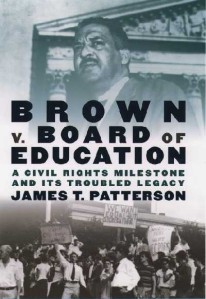
brown-v-board-of-educationOn May 17, 1954, the Warren Court’s unanimous (9-0) decision stated that “separate educational facilities are inherently unequal.” This was the day that the landmark Brown v Board of Education Supreme Court decision changed the face of America unlike any other decision before or since.

This major ruling was the cornerstone that laid the foundation for all of the civil rights African American’s know today, just as the late Thurgood Marshall, who brilliantly argued and won this case envisioned. It is also very appropriate to recognize the skillful talent of Justice Marshall for his more than fifty victories before the Supreme Court, more than any other attorney in history.

The Brown Case, as it is known, was not the first such case regarding civil rights argued before the Supreme Court. It was just the most significant of what some would say was the final battle in the courts that had been fought by African American parents since 1849, which started with Roberts v. City of Boston, Massachusetts. It is also important to note that Kansas was the site of eleven such cases spanning from 1881 to 1949.

The case was named after Oliver Brown one of 200 plaintiffs. The Brown case was initiated and organized by the National Association for the Advancement of Colored People (NAACP) leadership who recruited African American parents in Topeka, Kansas for a class action suit against the local school board. The Supreme Court combined five cases under the heading Brown v. Board of Education: Delaware, Kansas, South Carolina, Virginia, and the District of Columbia. The ultimate goal sought by the NAACP was to end the practice of “separate but equal” throughout every segment of society, including public transportation, dining facilities, public schools and all forms of public accommodations.

The Brown Supreme Court ruling determined racial segregation in public education was unconstitutional in Brown I, the first opinion. The court’s implementation mandated "with all deliberate speed" in 1955 known as Brown II. In 1979, twenty five years later, there was a Brown III because Topeka was not living up to the earlier Supreme Court ruling, which resulted in Topeka Public Schools building three magnet schools to comply with the court's findings.

As had been the case since Homer Plessy, the subject in Plessy v. Ferguson in 1896 when the U.S. Supreme Court decided that a Louisiana law mandating separate but equal accommodations for blacks and whites on intrastate railroads was constitutional. This decision provided the legal foundation to justify many other actions by state and local governments to socially separate blacks and whites.

Now that I have provided some history related to the case let me add my commentary. It has been said that as sure as things change they remain the same. First, it took 60 year to overturn Plessy with Brown and it took “with all deliberate speed” 13 years for integration to begin fully. During this period of time from 1954 to 1967, governors blocked school entrances and actually closed schools rather than comply with the law of the land. I am not going to touch on the violence that caused Presidents to send the US Army and National Guard troops to schools in order to protect the safety of those the ruling was intended benefit as a result of the Brown decision.

Since then, and over time, many scams have been devised to disenfranchise minorities and African Americans in particular. I need only remind you of “No Child Left Behind” where we see persistent patterns of underachievement for lower-income students on standardized test scores. These standardized tests serve as gatekeepers to a child's academic future, which I don’t believe was the spirit of the Brown case.

Malcolm X famously said, only a fool would allow his enemy to educate his people. Just think about the deplorable education system and the fact that most of what is taught, particularly when it comes to history, is a fallacy. Then consider the extremely high dropout rates among our children. For example, it has been reported that in the City of Baltimore more than two thirds of all students who enter high school do not graduate.

After fifty-five years, it is not unreasonable to seek and ask that the spirit of Brown be honored with effective and meaningful equal rights under the law. I understand that public education was not created to develop minds rather it was intended to simply teach reading, writing, and arithmetic. It was created to maintain a permanent underclass. Much like it was then, a travesty, in many ways it remains a travesty for the children in most Urban Public School System’s.

I, like Dr. King believe in the dream but we have unfinished business and as it stands - it is a dream deferred. That’s why it is imperative for us to celebrate this milestone and continue the struggle as the ghosts of so many greats who died for this principle: “education is the single most important ingredient necessary to neutralize those forces that breed poverty and despair”.

And that’s my Thought Provoking Perspective…


Friday, February 15, 2013

The First Civil Rights Martyr


Medgar Wiley Evers was born in Decatur, Mississippi on July 2, 1925; dying the victim of a racially motivated assassination on June 12, 1963 in Jackson, Mississippi after attending a rally. He was the third of four children of a small farm owner who also worked at a nearby sawmill. His social standing was impressed upon him every day but Evers was determined not to cave in under such pressure. He once said his mission was evident at the age eleven or twelve when a close friend of the family was lynched.

He walked twelve miles each way to earn his high school diploma and joined the Army during the Second World War. Perhaps it was during the years of fighting in both France and Germany for his and other countries' freedom that convinced Evers to fight on his own shores for the freedom of blacks. After serving honorably in the war he was discharged in 1946, he began working for the National Association for the Advancement of Colored People (NAACP) in 1952. Evers travelled throughout the state of Mississippi trying to encourage voter registration and worked tirelessly to enforce federally mandated integration laws.

On 12 June 1963, hours after President John F. Kennedy gave a televised speech condemning segregation, Evers was shot in the back by a high-powered rifle while returning home. He crawled to the house and collapsed in front of his wife and three children; he died an hour later. The rifle found at the scene belonged to Byron De La Beckwith, a member of the all-white Citizens' Council, a statewide group opposed to racial integration akin to the KKK.

Beckwith was tried twice but nearly thirty years later, thanks to the persistence of Evers' widow, Myrlie Evers-Williams, the case was reopened and Beckwith was tried and convicted in 1994, and the conviction was upheld by the state supreme court in 1997. Evers-Williams published “For Us, The Living in 1967”; Beckwith's trial was the basis for the 1996 film Ghosts of Mississippi that starred Whoopi Goldberg.

Medgar Evers position in the civil rights movement was that of field secretary for the NAACP and recognized as one of the first martyrs of the civil rights movement. His death prompted President John Kennedy to ask Congress for a comprehensive civil rights bill, which President Lyndon Johnson signed into law the following year.
The Mississippi in which Medgar Evers lived was a place of blatant discrimination where blacks dared not even speak of civil rights, much less actively campaign for them. Evers, a thoughtful and committed member of the NAACP wanted to change his native state. He paid for his convictions with his life, becoming the first major civil rights leader whose death was called an assassination.

Evers was featured on a nine-man hit list in the Deep South as early as 1955. He and his family endured numerous threats and other violent acts, making them well aware of the danger surrounding his activism. Still he persisted in his efforts to integrate public facilities, schools, and restaurants. He organized voter registration drives and demonstrations. He spoke eloquently about the plight of his people and pleaded with the all-white government of Mississippi for some sort of progress in race relations. To those people who opposed such things, he was thought to be a very dangerous man.

In some ways, the death of Medgar Evers was a milestone in the hard-fought integration war that rocked America in the 1950s and 1960s. While the assassination of such a prominent black figure foreshadowed the violence to come, it also spurred other civil rights leaders, also targeted by white supremacists, to new fervor. They, in turn, were able to infuse their followers with a new and expanded sense of purpose; one that replaced apprehension with anger.

Evers must have also had a sense that his life would be cut short when what had begun as threats turned increasingly to violence. A few weeks prior to his death, someone threw a firebomb at his home. Afraid that snipers were waiting for her outside, Mrs. Evers put the fire out with the garden hose. The incident did not deter Evers from his rounds of voter registration or from his strident plea for a biracial committee to address social concerns in Jackson. His days were filled with meetings, economic boycotts, marches, prayer vigils, and picket lines and with bailing out demonstrators arrested by the all-white police force. It was not uncommon for Evers to work twenty hours a day.

The NAACP posthumously awarded its 1963 Spingarn medal to Medgar Evers. It was a fitting tribute to a man who had given so much to the organization and had given his life for its cause. Perhaps the most encouraging aspect of Medgar Evers's story lies in the attitudes of his two sons and one daughter. Though they experienced firsthand the destructive ways of bigotry and hatred; Evers' children appear to be very well-adjusted individuals. Myrlie Evers remarked that "it has taken time to heal the wounds [from their father's assassination] and I'm not really sure all the wounds are healed. We still hurt, but we can talk about it now and cry about it openly with each other, and the bitterness and anger have gone."

As a fitting tribute, Evers was interred at Arlington National Military Cemetery in Washington DC. How many of you are willing to give your life for something greater than yourself? And that’s my Thought Provoking Perspective…


[youtube http://www.youtube.com/watch?v=8_HBdrJkmDE&fs=1&hl=en_US]

Thursday, February 14, 2013

The First Lady of Civil Rights


This is the story of Rosa Louise McCauley Parks who was greatest, most distinguished African American Woman Civil Rights Activist of our time. The woman known as “The First Lady of Civil Rights"; born February 4, 1913 in Tuskegee, Alabama. Her ancestry was a mixture of African American, Cherokee-Creek and Scots-Irish, which some say accounts for her fair complexion.

Mrs. Parks was highly respected within the local community, as in many segregated communities it was close knit and intertwined. She was secretary of the Montgomery chapter of the NAACP and had recently attended the Highlander Folk School which was a Tennessee center for workers' rights and racial equality. Although widely honored in later years for her action, she suffered for it, losing her job as a seamstress in a local department store. Eventually, having to leave Alabama for Detroit Michigan, where she found similar work.

Mrs. Parks remarked that it was the horrifying murder of Emmett Till, in August 1955 was on her mind that day when she proclaimed to be tired of giving in. On November 27, 1955, only four days before she refused to give up her seat, she had attended a mass meeting in Montgomery which focused on this case as well as the recent murders of George W. Lee and Lamar Smith. All of this and the countless crimes perpetrated by southern whites cause her to say “enough”.

After leaving work on December 1, 1955 in Montgomery, Alabama, Mrs. Parks, then 42, refused to obey the driver of the segregated city bus system who ordered her to give up her seat to make room for a white passenger. Her arrest was the catalyst for a bus boycott that would cripple the city of Montgomery lasting nearly thirteen months. This event lead to what many view as the birth of the modern civil rights movement.

Many believe this act was the first of its kind in the rigidly segregated south but it was not. In 1946 Irene Morgan, and in 1955 Sarah Louise, won rulings before the U.S. Supreme Court, and the Interstate Commerce Commission, respectively, relating to interstate bus travel. Just nine months before Parks refused to give up her seat, 15-year-old Claudette Colvin refused to move from her seat on the same bus system.

Lest we forget that in 1944, athletic star Jackie Robinson took a similar stand in a confrontation with a US Army officer in Texas, refusing to move to the back of a bus. Robinson was brought before a court martial, which acquitted him. The NAACP had accepted and litigated other cases before, such as that of Irene Morgan ten years earlier, which resulted in a victory in the U.S. Supreme Court, and the Interstate Commerce Clause grounds. The difference as it relates to the many individuals whose arrests for civil disobedience was that Mrs. Parks’ actions sparked the Montgomery Bus Boycott.

Let’s journey back to a time when Jim Crow was the law in America, black and white people were segregated in virtually every aspect of daily life and not just in the South. Bus and train companies did not provide separate vehicles for the different races but did enforce seating policies that allocated separate sections for blacks and whites. School bus transportation was unavailable in any form for black school children in the South.

Before I go any further, on Montgomery buses there was a separation point, the first four rows of bus seats were reserved for white people. Buses had "colored" sections for black people, who made up more than 75% of the bus system's riders, generally in the rear of the bus. These sections were not fixed in size but were determined by the placement of a movable sign. Black people could sit in the middle rows, until the white section was full. Then they had to move to seats in the rear, stand, or, if there was no room, leave the bus.

Black people were not allowed to sit across the aisle from white people. The driver also could move the "colored" section sign, or remove it altogether. If white people were already sitting in the front, black people could board to pay the fare, but then had to disembark and reenter through the rear door. There were times when the bus departed before the black customers who had paid made it to the back entrance.

For years, the black community had complained that the situation was unfair, and Parks was no exception: "My resisting being mistreated on the bus did not begin with that particular arrest...I did a lot of walking in Montgomery." Parks had her first run-in on the public bus on a rainy day in 1943, when the bus driver, James F. Blake, demanded that she get off the bus and reenter through the back door. 

As she began to exit by the front door, she dropped her purse. Parks sat down for a moment in a seat for white passengers to pick up her purse. The bus driver was enraged and barely let her step off the bus before speeding off. Ironically that fateful day when she refused to give up her seat, it was the same driver who she would encounter.

It was shortly after the landmark Plessey v Ferguson case that ushered in “separate but equal” in America when Montgomery passed a city ordinance for the purpose of segregating passengers by race. Conductors were given the power to assign seats to accomplish that purpose; however, no passengers would be required to move or give up their seat and stand if the bus was crowded and no other seats were available. Over time and by custom, however, Montgomery bus drivers had adopted the practice of requiring black riders to move whenever there were no white only seats left.

So, following standard practice, bus driver Blake noted that the front of the bus was filled with white passengers and there were two or three men standing, and thus moved the "colored" section sign behind Parks and demanded that four black people give up their seats in the middle section so that the white passengers could sit. Years later, in recalling the events of the day, Parks said, "When that white driver stepped back toward us, when he waved his hand and ordered us up and out of our seats, I felt a determination cover my body like a quilt on a winter night."

By Parks' account, Blake said, "Y'all better make it light on yourselves and let me have those seats." Three of them complied. Parks said, "The driver wanted us to stand up, the four of us. We didn't move at the beginning, but he says, 'Let me have these seats.' And the other three people moved, but I didn't." The black man sitting next to her gave up his seat. Parks moved, but toward the window seat; she did not get up to move to the newly repositioned colored section. Blake then said, "Why don't you stand up?" Parks responded, "I don't think I should have to stand up."

Blake called the police to arrest Parks. When recalling the incident for Eye on the Prize, a 1987 public television series on the Civil Rights Movement, Parks said, "When he saw me still sitting, he asked if I was going to stand up, and I said, 'No, I'm not.' And he said, 'Well, if you don't stand up, I'm going to have to call the police and have you arrested.' I said, 'You may do that.” He did and the world changed that moment.

“People always say that I didn't give up my seat because I was tired, but that isn't true. I was not tired physically, or no more tired than I usually was at the end of a working day. I was not old, although some people have an image of me as being old then. I was forty-two. No, the only tired I was, was tired of giving in.”

Remember her, never forget her, and honor her for all times. And that's my Thought Provoking Perspective!!!

Just a Season
Legacy – A New Season 

Wednesday, February 13, 2013

Black Codes


blackThere have been many ways to suppress people over time; unfortunately, African Americans have endured the brunt of these efforts. Of course, as you know, the history of America reports that it was not only African American’s subjected or affected by these efforts. What I can report is that it was always a minority most affected by these laws to ensure a permanent underclass.

This ideology began as indentured servants, then slavery, segregation, and now could it be conservatism. In each of these classifications they called these laws Black Codes, which I suppose make the immoral sanctions sound kinder. The truth is its sole purpose was to suppression the vote. Kinda like the agenda behind the States Rights dog whistles we hear today.

Black Codes were laws passed designed specifically to take away civil rights and civil liberties of African American on the state and local level. This is the reason Conservatives desire a return to “States Rights” and speak of taking back our country because at the state level they can be unimpeded in turning back the hands of time.

Although, most of the discriminatory legislation, in terms of Black Codes, were used more often by Southern states to control the labor, movements and activities of newly freed slaves at the end of the Civil War. But as Malcolm X once said, “Anywhere south of Canada was south” meaning wherever you were in America you were subjected to discrimination in terms of the “separate but equal” laws of the land.

The Black Codes of the 1860’s are not the same as the Jim Crow laws. The Black Codes were in reaction to the abolition of slavery and the South's defeat in the Civil War. Southern legislatures enacted them during Reconstruction. The Jim Crow era began later, nearer to the end of the 19th century after Reconstruction, with its unwritten laws.

Then there were sundown laws, which meant Blacks, could not live or be caught in certain towns after dark. In some cases, signs were placed at the town's borders with statements similar to the one posted in Hawthorne California that read “Nigger, Don't Let The Sun Set On YOU In Hawthorne" in the 1930’s. In some cases, exclusions were official town policy, restrictive covenants, or the policy was enforced through intimidation.

After the abolition of slavery by the Thirteenth Amendment of the United States Constitution, which prior to that African Americans were considered 3/5’s human. Therefore, all former slave states adopted Black Codes. During 1865 every Southern state passed Black Codes that restricted the Freemen, who were emancipated but not yet full citizens. While they pursued re-admission to the Union, the Southern states provided freedmen with limited second-class civil rights and no voting rights. Southern plantation owners feared that they would lose their land. Having convinced themselves that slavery was justified, planters feared African Americans wouldn't work without coercion. The Black Codes were an attempt to control them and to ensure they did not claim social equality.

The Black Codes outraged public opinion in the North because it seemed the South was creating a form of quasi-slavery to evade the results of the war. After winning large majorities in the 1866 elections, the Republicans put the South under military rule. They held new elections in which the Freedmen could vote. Suffrage was also expanded to poor whites. The new governments repealed all the Black Codes; they were never reenacted - OFFICIALLY.

Many of these things are unknown to the generations of today because these injustices have been erased from our history and very little of it is taught in today’s classroom. For example, a sundown town was a town that was all white on purpose. The term was widely used in the United States and Canada in areas from Ohio to Oregon and well into the South. Even in Canada many towns in Southern Ontario, Alberta, and Quebec, were sundown towns prior to 1982, when it was outlawed. The term came from signs that were allegedly posted stating that people of color had to leave the town by sundown. They were also sometimes known as “sunset towns” or “gray towns”. Let me ask if you have ever been to a million dollar community – sound familiar.

The black codes that were enacted immediately after the Civil War, though varying from state to state, were all intended to secure a steady supply of cheap labor and all continued to assume the inferiority of the freed slaves. The black codes had their roots in the slave codes that had formerly been in effect. The premise behind chattel slavery in America was that slaves were property, and, as such, they had few or no legal rights. The slave codes, in their many loosely defined forms, were seen as effective tools against slave unrest, particularly as a hedge against uprisings and runaways. Enforcement of slave codes also varied, but corporal punishment was widely and harshly employed.

Let me highlight this example: In Texas, the Eleventh Legislature produced these codes in 1866. The intent of the legislation was to reaffirm the inferior position that slaves and free blacks had held in antebellum Texas and to regulate black labor. The codes reflected the unwillingness of white Texans to accept blacks as equals. You do remember “Juneteenth”? In addition, the Texans also feared that freedmen would not work unless coerced. Thus the codes continued legal discrimination between whites and blacks. The legislature, when it amended the 1856 penal code, emphasized the continuing line between whites and blacks by defining all individuals with one-eighth or more African blood as persons of color, subject to special provisions in the law.

Minorities were systematically excluded from living in or sometimes even passing through these communities after the sun went down. This allowed maids and workmen to provide unskilled labor during the day. Sociologists have described this as the nadir of American race relations. Sundown towns existed throughout the nation, but most often were located in the northern states that were not pre-Civil War slave states. There have not been any de jure sundown towns in the country since legislation in the 1960’s was inspired by the Civil Rights Movement, although de facto sundown towns and counties, where no black family lives - still exist.

Therefore, we see hints of it in the racism that has raised its ugly head and risen to the surface of society’s consciousness, particularly in this political climate. Since the Civil Rights Movement of the 1950s and 1960s, and especially since the Civil Rights Act of 1968 prohibited racial discrimination concerning the sale, rental, and financing of housing, the number of sundown towns has decreased.

However, as sociologist suggest it is impossible to precisely count the number of sundown towns at any given time, because most towns have not kept records of the ordinances or signs that marked the town's sundown status. It is important to note that sundown status meant more than just African Americans not being able to live in these towns. Essentially any African Americans or other groups who came into sundown towns after sundown were subject to harassment, threats, and violent acts; up to and including lynching.

As one historian has noted, "Racial segregation was hardly a new phenomenon because slavery had fixed the status of most blacks, no need was felt for statutory measures segregating the races. These restrictive Black Codes have morphed in one form or another to achieve its desired effect to maintain a superior status by the powers that be. I am only suggesting that we know and understand history for it will open the mind to what the future may present.

Frankly, if you don’t know where you came from you will never get to where you are going. And that’s my Thought Provoking Perspective!!!

Tuesday, February 12, 2013

Sojourner Truth: “Ain’t I a Woman?”


Throughout our existence in this place the slaves called “merica”. We have had many dynamic heroines, dare I say, none were more profound that Sojourner Truth. A woman who’s exact date of birth was not recorded. What we do know is in the year 1797, among Dutch immigrants in the region now known as Ulster County, New York, an African child was born on the estate of Colonel Johannes Hardenbergh.

One of 13 children born to Elizabeth and James Baumfree, she was given the name Isabella Baumfree. As the story goes, this name gave her no hint of her mission; years later she renamed herself Sojourner Truth. Her life was a testament to this mission as a truth-teller. In 1851, Sojourner Truth gave her famous “Ain’t I a Woman?” speech before the Women’s Rights Convention held in Akron, Ohio. Several ministers were in attendance. Truth rose from her seat and spoke the following words before the audience:

“Well, children, where there is so much racket there must be something out of kilter. I think that ‘twixt the negroes of the South and the women at the North, all talking about rights, the White men will be in a fix pretty soon. But what’s all this here talking about?
That man over there says that women need to be helped into carriages, and lifted over ditches, and to have the best place everywhere. Nobody ever helps me into carriages, or over mud-puddles, or gives me any best place! And ain’t I a woman?
Look at me! Look at my arm! I have ploughed and planted, and gathered into barns, and no man could head me! And ain’t I a woman? I could work as much and eat as much as a man – when I could get it – and bear the lash as well! And ain’t I a woman? I have borne thirteen children, and seen most all sold off to slavery, and when I cried out with my mother’s grief, none but Jesus heard me! And ain’t I a woman?
Then they talk about this thing in the head; what’s this they call it? [member of audience whispers, "intellect"] That’s it, honey. What’s that got to do with women’s rights or negroes’ rights? If my cup won’t hold but a pint, and yours holds a quart, wouldn’t you be mean not to let me have my little half measure full?
Then that little man in black there, he says women can’t have as much rights as men, ’cause Christ wasn’t a woman! Where did your Christ come from? Where did your Christ come from? From God and a woman! Man had nothing to do with Him.
If the first woman God ever made was strong enough to turn the world upside down all alone, these women together ought to be able to turn it back, and get it right side up again! And now they is asking to do it, the men better let them.
Obliged to you for hearing me, and now old Sojourner ain’t got nothing more to say.”
She underwent a number of transfers between slave-owners and suffered what she described as cruelties that one dare not imagine against a young African girl child enslaved in America. It is said that while living in the home of Isaac and Maria Van Wagenens, Truth had a life-changing religious experience. She started to speak in public assemblies. She became known as a gifted preacher. She joined the Progressive Friends, an organization established by the Quakers, which pressed forward the cause of abolishing slavery throughout America.

“In 1864, she worked among freed slaves at a government refugee camp on an island in Virginia and was employed by the National Freedman’s Relief Association in Washington, D.C.,” according to Women in History: Living vignettes of notable women from U.S. history. “In 1863, Harriet Beecher Stowe’s article “The Libyan Sibyl” appeared in the Atlantic Monthly; a romanticized description of Sojourner.”

At the end of the Civil War, Truth worked on behalf of the Freedman’s Hospital in Washington through the Freedman’s Relief Association. In 1867, she moved to Battle Creek, Michigan. While unsuccessful in her efforts, for several years she lobbied the U.S. federal government for land in the Western states for former enslaved Africans. Illness began to reduce her speaking tours. In 1879, she spent a year in Kansas City to help settling African migrants she called “Exodusters”. In addition to racial and gender equality issues, Truth campaigned against capital punishment and called for temperance.

On November 26, 1883, Sojourner Truth was surrounded by her family at her death bed. She was 86 years old when she died surrounded by her family in Battle Creek, Michigan. She was buried in Oak Hill Cemetery, next to her grandson’s gravesite. More than 200 years later, her legacy as a truth-keeper continues to ignite the imagination of the new nation for which she found herself in service. Sojourner Truth lived during times of great change.

First Lady Michelle Obama said of her at the April 28, 2009 commemorative ceremony unveiling the Sojourner Truth bronze bust. “I hope that Sojourner Truth would be proud to see me, a descendant of slaves, serving as the first lady of the United States of America. Now many young boys and girls, like my own daughters, will come to Emancipation Hall and see the face of a woman who looks like them.”

This is a shoot-out to the ghost and spirit of one of the greatest women to live. And that is my Thought Provoking Perspective…

Legacy – A New Season 
Just a Season

Monday, February 11, 2013

An Unsung Hero Of The Movement


fannyFannie Lou Hamer impactful, yet unknown civil rights activist of the movement whose passionate depiction of her own suffering in a racist society helped focus attention on the plight of African Americans throughout the South. While working with the Student Non-Violent Coordinating Committee (SNCC) in 1964; Hamer helped organize the 1964 Freedom Summer African American voter registration drive in her native Mississippi. Civil rights activist.

Born Fannie Lou Townsend on October 6, 1917 in Montgomery County, Mississippi the daughter of sharecroppers, Hamer began working the fields at an early age. Her family struggled financially, and often went hungry. In the summer of 1962, she made a life-changing decision to attend a protest meeting. She met civil rights activists there who were there to encourage African Americans to register to vote.

Hamer became active in helping with the voter registration efforts, which few in Mississippi were brave enough to do. Hamer dedicated her life to the fight for civil rights, working for the Student Nonviolent Coordinating Committee (SNCC) after going involved with the struggle. This organization was comprised mostly of African American students who engaged in acts of civil disobedience to fight racial segregation and injustice in the South. These acts often were met with violent responses by angry whites.

At the Democratic National Convention later that year, she was part of the Mississippi Freedom Democratic Party, an integrated group of activists who openly challenged the legality of Mississippi's all-white, segregated delegation. For her devotion and commitment she paid a heavy price. She was beaten within an inch of her life. So brutally that it took months for her to recover but she never gave up the fight.

During the course of her activist career, Hamer was threatened, arrested, beaten, and shot at but none of these things deterred her from her work. In 1964, Hamer helped found the Mississippi Freedom Democratic Party, which was established in opposition to the state’s all-white delegation to that year's Democratic convention. She brought the civil rights struggle in Mississippi to the attention of the entire nation during a televised session at the convention.

The next year, Hamer ran for Congress in Mississippi but was unsuccessful in her bid. Along with her political activism, Hamer worked to help the poor and families in need in her Mississippi community. She also set up organizations to increase business opportunities for minorities and to provide childcare and other family services.

Hamer died of cancer on March 14, 1977 from cancer. The encryption on her tombstone in her hometown of Ruleville, Mississippi denotes her famous quote, "I am sick and tired of being sick and tired." I ask you, when will this statement impact your life whereas you will affect change. And that’s my Thought Provoking Perspective…

Sunday, February 10, 2013

MURDER IN MONEY


On August 28, 1955, Emmett Till, a fourteen-year-old black boy from Chicago supposedly whistled at a white woman in a grocery store. The murder of this 14-year old Emmett Till in Money, Mississippi sparked the Civil Rights Movement. The crime sound clarion calls for a nation to wake up – just look at the photo. Till’s mutilated corpse circulated around the country mainly because of John Johnson who published the gruesome photographs in Jet magazine, a predominately African American publication. The photo drew intense public reaction.

Till didn't understand or knew that he had broken an unwritten law of the Jim Crow South until three days later, when two white men dragged him from his bed in the dead of night, beat him brutally and then shot him in the head. That night the door to his grandfather’s house was thrown open and Emmett was forced into a truck and driven away never again to be seen alive again. Till’s body was found swollen and disfigured in the Tallahatchie river three days after his abduction and only identified by his ring.

Till’s body was sent back to Chicago, where his mother insisted on leaving the casket open for the funeral and having people take photographs because she wanted people to see how badly Till’s body had been disfigured. This courageous mother was famously quoted as saying, “I wanted the world to see what they did to my baby.” Up to 50,000 people viewed the body.

On the day he was buried, two men — the husband of the woman who had been whistled at and his half brother — were indicted of his murder, but the all white male jury from Money (some of whom actually participated in Till’s torture and execution) took only an hour to return ‘not guilty’ verdict. The verdict would have been quicker, remarked the grinning foreman, if the jury hadn’t taken a break for a soft drink on the way to the deliberation room. To add insult to injury, knowing that they would not be retrial, the two accused men sold their stories to LOOKMagazine and gleefully admitted to everything.

Elsewhere in Mississippi at the time things weren’t going terribly well for blacks either. Just before Till was murdered, two activists Rev. George Lee and Lamar Smith were shot dead for trying to exercise their rights to vote, and in a shocking testimony to lack of law and order, no one came forward to testify although both murders were committed in broad daylight.

The next year, Clyde Kennard, a former army sergeant, tried to enroll at Mississippi South College in Hatiesburg in 1956. He was sent away, but came back to ask again. For this ‘audacity’, university officials — not students, or mere citizens, but university officials — planted stolen liquor and a bag of stolen chicken feed in his car and had him arrested. Kennard died halfway into his seven year sentence.

Emmett-Till-300x300But times were slowly a-changing: Brown vs. Board of Education was decided in 1954. Three months after the Till murder Rosa Parks would refuse to move to the back of a bus in Montgomery, Alabama. Sit-ins and marches would follow, and soon the civil rights movement itself would be in full-swing. It’s been over sixty-years since the events of that fateful night and I simply cannot find the words to describe this heinous crime that has yet to receive justice.

So I’ll end by sharing these words by Maya Angelou: “history, despite its wrenching pain, cannot be unlived, but if faced with courage, need not be lived again.” And that’s my Thought Provoking Perspective!

YOU MUST SEE THIS!!!


The Whole Story


Purchase “Just a Season” today !!!
Legacy – A New Season

Saturday, February 9, 2013

By Any Means Necessary


Malcolm X was no doubt one of the most profoundly significant, famous, and controversial African American leaders of our time. I cannot recall any other MAN, except maybe Dr. King, whose impact was so overwhelmingly felt by so many. Minister Malcolm’s prophetic words spoken over forty-five years ago resonate as relevant today as the day they were spoken evoking the same emotions of truth.

February 21st is the anniversary, for lack of a better word, of Minister Malcolm X’s assassination at the Audubon Ballroom that has yet to be fully resolved in the minds of most of us. What I can say is that we lost a champion unlike any I’ve witnessed in my lifetime. Therefore, it would be blasphemy to dedicate an entire month to the ghost of the greats and not include the most articulate orator of our time.

I could go deeper into the making of this man but so many people, agencies, institutions and organizations have covered this great man’s brief life on earth in much more detail than I can. As you know, there is a vast sea of in-depth analyses, books, movies, and biographies on his life and philosophies. I will not try to rewrite history rather simply pay homage to the legacy of this great man as brief as I can, honoring him for his contributions to the African American Diaspora.

There are facts (known & unknown), suspicions and of course theories surrounding the assassination of Malcolm X, the impact it has had on our culture and the world. Like the Reverend Dr. Martin Luther King, Malcolm X also had a dream. It began bathed in the tenets of anger and hatred, fostering economic independence on the shoulders of retaliatory separatism that ended with the swelling acceptance of a unified brotherhood and the replacement of hatred with peace and with the nagging thirst for international equality for all mankind.

As the story goes, early in Malcolm’s life a white teacher asked him what he would like to be and his answer was “a lawyer”. The teacher, who had encouraged his white students on their career choices, told Malcolm, “That’s no realistic goal for a nigger”. This statement discouraged a bright student to not seek his full potential leading to a life of crime. After being caught and arrested for carrying a concealed weapon he was sentenced to prison. While serving more than six years he began educating himself, converted to the Islamic faith and became a Black Muslim in the Nation of Islam (NOI).

After his release in 1952, Malcolm Little, now known as Malcolm X, went to Detroit and began to actively preach to the frustrated African American population about what Islam had to offer. It made no difference where he conducted his sermons and teachings, whether on the streets or in a temple. He spread the word to anyone who would listen.

It was not long before Malcolm became a favorite of Elijah Muhammad, the leader of the Nation of Islam. He was made a minister and began to travel from city to city, preaching the message, founding new temples and converting thousands of people to the faith. Two years later, Malcolm X became minister of the famed Temple Number Seven in Harlem, New York.

In April of 1964, Malcolm X made a pilgrimage to Mecca which led to his second conversion. He met brothers of the faith who were from many nations and of many races, black, brown, white, and all the sons of Allah. The reality dawned on him that advocating racial cooperation and brotherhood would help resolve the racial problems in America and, hopefully, lead to a peaceful coexistence throughout the world. Malcolm X’s transformed ideas and dreams reached full fruition and were ready for implementation. He changed his name, this time to El-Hajj Malik El-Shabazz and found himself going against the system.

It did not take long for the reactionaries to strike out at Malcolm X. Members of the NOI resented what they thought were his attempts to supplant Elijah Muhammad. Government entities feared his involving the NOI in international issues, as well as his starting to lean too far to the left, while law enforcement officials looked upon him and his actions as radical, criminal and detrimental to society.

Early on the morning of February 14, 1965, Malcolm and his family were peacefully asleep in their home in Elmhurst, New York. They were suddenly awakened by the sounds of shattering glass and explosions. Several Molotov cocktails had been thrown through their living room window, engulfing the house in roaring flames. Malcolm and his wife, Betty, quickly gathered their children and rushed out of the burning house. Once safe, they stood outside in the cold air, watching as their home and possessions burned. It was never determined who had tried to kill them, though Malcolm did tell authorities he thought it may have been the NOI.

Just one week later at a scheduled appearance at the Audubon Ballroom, which was almost full on a cold February day with over 400 followers of Islam anxiously awaiting Brother Malcolm X. No uniformed police were visible inside the Audubon, but two were stationed outside the entrance although it was common knowledge that an attempt on Malcolm’s life was a real possibility. Inside the Audubon Ballroom, several dark-suited NOI guards were positioned near the stage and towards the rear of the room. As soldiers of the NOI, the militancy of the neatly dressed men was evident in their demeanor, as they surveyed the room, quietly watching the seating of late arrivals.

Malcolm X, his pregnant wife and their four children waited as a tense and nervous Malcolm X ordered two of his guards to take his family out into the hall to their seats in a box near the front of the stage. Seemingly irritated and exhausted, Malcolm X mentioned to his aides that he had reservations about speaking. Malcolm’s misgivings were reflected in his taut features as his restless eyes darted around the room as he listened to Brother Benjamin Goodman making his opening speech.

At approximately 3:08 pm, Brother Benjamin ended his speech and introduced Malcolm X, who walked out onto the stage to a lengthy ovation. Malcolm stepped up to a wooden podium and looked out at the audience. When the applause finally settled down, he offered the audience the Muslim greeting and smiled when they responded in-kind. Just as he began to speak again, a commotion broke out near the rear of the ballroom.

Two men jumped up, knocking wooden folding-chairs to the floor, as one of the men yelled, “Get your hand out of my pocket!” As Malcolm responded with cool it there brothers, a loud explosion suddenly erupted in the back of the room, which began to fill with smoke.

Malcolm’s bodyguards and aides hardly had time to react as the well coordinated ruses effectively diverted their attention from him, allowing unopposed gunmen to begin their attack. A man rose from the front row and pulled out a double-barreled sawed-off shotgun from under his coat and fired twice at Malcolm. Simultaneously, as Malcolm was falling backwards and clutching his bloody chest, two more men jumped up and fired pistols at him as they rushed the stage. Although Malcolm was down, the two men repeatedly fired bullets into his body before turning and running to flee the premises. More shots were fired as they ran.

Upon learning of the assassination of Malcolm X, the Reverend Dr. Martin Luther King, Jr. remarked that “One has to conquer the fear of death if he is going to do anything constructive in life and take a stand against evil”. We may never know all of the facts about who was behind the assassination or who ordered his death. But we do know that these assassins denied him the chance to act upon his newly formed convictions.

Today, the man and the name, Malcolm X, are known in America and throughout the world. He was a celebrated freedom fighter and motivating force to those whose future he had the vision to see, the will to stand up and fight for. Postage stamps and posters now bear his image out of recognition and honor for his final crusade.

The eulogy that actor Ossie Davis delivered at his funeral profoundly impresses upon us that, “However we may have differed with him, or with each other about him and his value as a man, let his going from us serve only to bring us together, now. Consigning these mortal remains to earth, the common mother of all, secure in the knowledge that what we place in the ground is no more now a man but a seed which, after the winter of our discontent, will come forth again to meet us. And we will know him then for what he was and is a Prince, our own black shining Prince! Who didn’t hesitate to die, because he loved us so.”

Malcolm X was a man who fulfilled his place in history and stayed true to his words: "It is a time for martyrs now, and if I am to be one, it will be for the cause of brotherhood." And That's my Thought Provoking Perspective...


"Just a Season"
 Legacy – A New Season

Friday, February 8, 2013

Michael Jackson


Michael_Jackson_by_RobertoBizamaHe who was the “Thriller”, Michael Jackson Dubbed the King of Pop, went on to become one of the most internationally famous award-winning solo pop sensations in all of history. I have yet to write about Michael as have written about many.

I would be re-missed if as we celebrate Black History Month if I did not pay homage to the greatest entertainer to ever life. I chose not to talk about his personal life because I don’t know anything about it.

However, I know enough to know that when someone rises so far above all others, there are those intent upon that persons destruction. For those people who rebuked him in life I say, Michael was ours and we knew his heart because it was the music of his soul.

Lest not forget that the Bible says "He who is without sin cast the first stone. So celebrating the man we grew up with and knew as “MJ”. LET’S REMEMBER THE MAN AND HIS MUSIC. Rest In Peace. And that’s my Thought Provoking Perspective…

[youtube http://www.youtube.com/watch?v=j-XOEFUPmr0]