Showing posts with label Dr. Martin Luther King. Show all posts

Friday, March 28, 2014

King Family Sacrifices


01t/16/arve/g2351/014During this passage through time there are milestones, mountains, and valleys that everyone will encounter. I would be hard press to think of a family with more adversity than the King Family.

Most people know the amazing stories about the life of Dr. Martin Luther King, Jr. They know about his most famous speech, his legendary marches and the principals by which he lived his life. What most people do not know is what happened to his family. There are stories about the numerous tragedies endured by the Kennedy family, but after reading this, you might know that the King family could give them a run for their money as it relates to heartbreak.

Alberta King, Dr. King’s mother, was shot and killed in 1974 while playing the organ at her church. The shooting was allegedly done by a 23-year old black man by the name of Marcus Wayne Chenault. Chenault didn’t give any reason for the shooting, except to say that “all Christians are my enemies.” Martin’s father, who was his greatest inspiration long before he learned from the teachings of Gandhi, lived a long life, dying at the age of 84.

Shortly after Dr. King’s death in 1968, Martin’s brother Alfred became co-pastor at Ebenezer Baptist Church, where his father and brother preached. In July of 1969, just a few days before his 39th birthday, Alfred was found dead in a swimming pool. The case was ruled as an accidental drowning, but many speculate something more sinister might have happened. According to his father, he was a good swimmer.
The sacrifice of the King family is indicative of the tremendous sacrifice made by those who have fought for the freedom of African Americans over the last 400 years. From the first runaway slave to today, the battle continues and it usually has a price.

Teach this lesson to your children. Tell them in the oral tradition of our ancestors and our march to freedom because our struggle is without question the greatest story ever told. Remind them that they stand on the shoulders of giants and they have a responsibility to continue the difficult journey as was done for them. And that’s my Thought Provoking Perspective…


Monday, January 20, 2014

In Dr. King’s Own Words

3On this great day, Reverend Dr. Martin Luther King, Jr. Holiday is wonderfully inspiring to behold. The ethos of the body King touches my spirit each January during the celebration of his day. As far as I’m concerned he was the most revered leader of our time.
Dr. King's legacy was to secure progress of civil rights for the American Negro and poor people in the United States, and for this reason he has become a human rights icon recognized as a martyr. He was posthumously awarded the Presidential Medal of Freedom, the Congressional Gold Medal, a National Holiday, and will be honored with a monument on the Washington Mall in DC.
Although, his true story has been sanitized to where most view him as a dreamer. This characterization of his is not correct. Let us remember Dr. King as the revolutionary he was; he, like Moses, saw this country as the Egypt of our time. I would ask that you listen to “The King” in his own words. The attached video is, in my view, one of his most succinctly clearly spoken words concerning the American Myth.
LISTEN TO DR. KING IN HIS OWN WORDS
HAPPY KING DAY! And that’s my thought provoking perspective…

Sunday, January 19, 2014

When Harlem Saved A King

1787788_orig
In September 1958, Dr. King was an emerging activist who was hosting a book signing for his book, “Stride Toward Freedom: The Montgomery Story” at Blumstein Department Store in Harlem, New York. On that day Dr. Martin Luther King was almost taken from us. Imagine what our lives and the world would be like today – if he had not survived the attack. Not many people know the name Izola Curry or that Dr. King barely escaped death that day.
While signing books, Dr. King was approached by a 42-year-old black woman, Izola Ware Curry, who asked if he was really Martin Luther King Jr. After responding yes, witnesses say Curry promptly took a letter opener out of her purse, closed her eyes and plunged it into Dr. King’s chest.
With the help of local police officers, first responders and the Harlem Hospital surgical team, Dr. King fortunately survived the stabbing, but doctors said because the opener grazed the surface of his aorta, if she had stabbed harder or if someone removed the object improperly, he probably would have drowned in his own blood.
“If I had sneezed, I wouldn’t have had a chance later that year, in August, to try to tell America about a dream that I had had. If I had sneezed, I wouldn’t have been down in Selma, Alabama to see the great movement there,” Dr. King famously said ten years after the incident in his last speech, ”I’ve Been to the Mountaintop.”
While local media reported Dr. King’s attempted assassination in the following weeks, the story did not become national news because he was not a prominent public figure at the time.
But mystery remains surrounding attacker Izola Curry. Who was she? What happened to her? And why did this woman attempt to kill one of the greatest civil rights leaders?
Two filmmakers claim that their upcoming documentary, When Harlem Saved A King, will answer all of these questions and also shed light into Curry’s life, who has remained, as of now, virtually unknown to the public.
“Everybody is fascinated with this story about Dr. Martin Luther King. Everything you hear about him is from history books, but this puts a different spin on Dr. Martin Luther King’s rise to fame and it’s absolutely true,” says executive producer Wayne Davis in an interview with theGrio.
While the mystery behind Curry is alluring to historians and the public alike, both the director, Al Cohen, and Davis, say their film will also pay homage to the “unsung heroes” from the Harlem community who helped save Dr. King’s life.
“Harlem was never given a badge of honor as it relates assisting in the Civil Rights Movement. This particular project that we’re doing helps bring that shade to the Harlem community. We can stand up tall and realize that we had a very major impact in the Civil Rights Movement,” said director Al Cohen in the interview.
The two Harlem natives have spent the past several years researching and tracking down firsthand sources and information to figure out what happened to Curry and community members who played a role in saving Dr. King.
“The objective of When Harlem Saved a King is to unravel mysteries, expose secrets and misconceptions; and answer unanswered questions. The pieces of this untold story will be woven into a compelling 60 minutes through the creative integration of eye-opening interviews [with firsthand witnesses],” according to the documentary’s website.
After the stabbing incident, Curry was taken into custody and was found to be incompetent to stand trial for assault charges. She was later diagnosed with paranoid schizophrenia and was committed to the Matteawan State Hospital for the criminally insane according to the Martin Luther King, Jr. Research and Education Institute.
Although the media portrayed Curry as a deranged woman with no real motive to kill Dr. King, both Cohen and Davis say that they have compelling evidence that Curry may have been part of a larger conspiracy to thwart the impending Civil Rights Movement.
“I think people will find an ironic twist about [the story]. Many said she was deranged woman, but it could possibly something bigger than that, a bigger conspiracy,” says Cohen. “It’s not just a crazy woman who got in an argument against [Dr. King] and just wanted to defend herself. It was more calculated than that.”
“For a deranged woman who acted solo, why was a lot of money in the south raised for her defense?” adds Davis. “That’s all I want to say. You will find out in the documentary what happened to her.”
Additionally, there are no records indicating Curry died at the mental institution and if she is still alive, she would be 96 years old today. Cohen and Davis say that the documentary will be groundbreaking because it will reveal what happened to Curry and if they were able to locate her.
“Nobody was ever able to get to [Izola Curry]. We have no information or any interviews or any leads about this woman, [except] the things we have found,” explains Cohen. “There is nobody out there that anybody has spoken to her outside of what we have found.”
The two filmmakers promoted their documentary throughout Black History Month to shed light onto a part of African-American history that has almost been forgotten. Just last week, the two hosted a screening of the trailer at Harlem Hospital.
“If Dr. King had died, would we be here talking with you today? We don’t know!” says Davis. “Maybe [the Civil Rights Movement] wouldn’t have progressed as soon as it did. Maybe it wouldn’t have progressed at all.”
The two filmmakers say that they are currently finishing the film’s production and they hope to premiere the documentary at the end of July.
I think this is a worthwhile project and one we should support. Therefore, I am reposting the article originally posted on theGrio to lend my support of this historical documentary. And that’s my Thought Provoking Perspective.

Wednesday, January 15, 2014

Dr. Martin Luther “The King”

3On this January day, the world was given the life of Dr. Martin Luther “The King”. I am grateful that God sent him to us with the special gift to change the world. Today, HIS-story speaks of the good reverend with profound reverence, in fact placing him second only to Jesus. Now, please understand that I believe Dr. King’s place in history is well deserved, secure, and beyond reproach. However, I lived through and during the time in which he lived meaning HIS-story does not accurately reflect what I remember, witnessed or know to be true.
Dr. King’s career or national presence began in 1955, when a seamstress refused to give up her seat on a segregated public bus in Birmingham, Alabama. He was responsible for the hugely successful boycott that paralyzed the city and forced changes to long held separate but equal policies. It was during this period that his home was bombed with his lovely wife and babies inside. He was arrested many – many times for peacefully asking for the most basic of human dignities. He was assaulted, stabbed, trampled by horses, and made out to be a communist. He was called a villain and names like “Martin Luther Coon”, and worst. In fact, he was viewed as a terrorist in his day.
During the time in which he lived it was well known in our community that Dr. King had a mutually antagonistic relationship with the government’s top police agency; particularly its director, who ordered surveillance of him and his organization for years. Wiretaps were placed in his home, office phones and they bugged his hotel rooms as he traveled around the country. The agency tried to discredit him through revelations regarding his private life. Reports regarding his supposed extramarital and sexual affairs were distributed to the executive branch, friendly reporters, funding sources, and potential coalition partners, as well as to his lovely wife.
They had followed his every step, yet claimed not to know who fired the shot. So in light of all this surveillance and counterintelligence activity it was not too difficult to conclude that they knew exactly who murdered him and all involved. When the culprit was arrested it was revealed that he was merely a petty thief who was not capable of robbing the Girl Scouts. Let me put this in context, this guy had a few hundred dollars in twenty dollar bills yet managed to escape traveling halfway around the world before being caught.
I can vividly recall that dreadful day, April 4th, 1968, asking the question most of us asked; how could the Prince of Peace be murdered? WHY? My knowledge of history tells me that anytime someone appears who has the power to change the system, eliminating the change agent is the system’s way of preservation. In other words the system is designed to protect the system. Aside from winning the Nobel Peace Prize, leaving us with brilliant written words, the enormous sacrifices risking his life, and losing it for peace – I honor this great man on this day and always. It is because of that wretched part of society that demonized him while he lived that we should appreciate his life and take into consideration as we celebrate his legacy.
My deepest heartfelt memory of Dr. King was the night before his death when he gave a speech that appeared as if he knew he was going to die. It was the most passionate speech I had ever heard. In that speech, he proclaimed that he’d been to the mountaintop and had seen the other side. Further, he proclaimed he did not fear any man for his eyes had seen the coming of the Lord.
HIS-story calls him a dreamer as they say he had a dream. I say, he was a brave visionary or maybe by exercising the wisdom of God’s gift that he could see the future. Dr. King’s left us with a very powerful message delivered August 28, 1963 on the Mall in front of the Lincoln Memorial in Washington DC via the famous “I have a Dream Speech” - (Excerpts):
• "In a sense we've come to our nation's capital to cash a check. When the architects of our republic wrote the magnificent words of the Constitution and the Declaration of Independence, they were signing a promissory note to which every American was to fall heir. This note was a promise that all men - yes, black men as well as white men - would be guaranteed the unalienable rights of life, liberty and the pursuit of happiness. It is obvious today that America has defaulted on this promissory note, insofar as her citizens of color are concerned. Instead of honoring this sacred obligation, America has given the Negro people a bad check, a check which has come back marked 'insufficient funds."
• "It would be fatal for the nation to overlook the urgency of the moment. This sweltering summer of the Negro's legitimate discontent will not pass until there is an invigorating autumn of freedom and equality. Nineteen sixty-three is not an end, but a beginning. Those who hope that the Negro needed to blow off steam and will now be content will have a rude awakening if the nation returns to business as usual."
• "The marvelous new militancy which has engulfed the Negro community must not lead us to a distrust of all white people. For many of our white brothers as evidenced by their presence here today have come to realize that their destiny is tied up with our destiny and they have come to realize that their freedom is inextricably bound to our freedom. We cannot walk alone."
• "I have a dream that one day this nation will rise up and live out the true meaning of its creed: 'We hold these truths to be self-evident, that all men are created equal."
• "I have a dream that my four little children will one day live in a nation where they will not be judged by the color of their skin, but by the content of their character."
• "I have a dream that one day on the red hills of Georgia the sons of former slaves and the sons of former slave owners will be able to sit down together at a table of brotherhood."
• "This is our hope. This is the faith that I go back to the South with. With this faith we will be able to hew out of the mountain of despair a stone of hope. With this faith we will be able to transform the jangling discords of our nation into a beautiful symphony of brotherhood. With this faith we will be able to work together, to pray together, to struggle together, to go to jail together, to stand up for freedom together, knowing that we will be free one day."
• "Now is the time to lift our nation from the quicksand of racial injustice to the solid rock of brotherhood. Now is the time to make justice a reality for all of God's children."
• "Let freedom ring. And when this happens, and when we allow freedom ring—when we let it ring from every village and every hamlet, from every state and every city, we will be able to speed up that day when all of God's children—black men and white men, Jews and Gentiles, Protestants and Catholics will be able to join hands and sing in the words of the old Negro spiritual: "Free at last! Free at last! Thank God Almighty, we are free at last!"
Never forget that injustice to anyone is an injustice to everyone. We can change the world but first we must change ourselves. The "Kings" message was simple like Moses he was saying “Let my people go". And that's my thought provoking perspective...

Saturday, August 24, 2013

A Great Show!

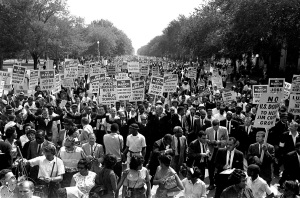
marchToday all eyes were on Washington as a celebration of the 50th Anniversary of the “March on Washington” for Jobs and Justice took place. August 28, 1963 marked a pivotal moment in America as the March on Washington, dubbed the greatest demonstration for freedom in the history of the United States. No question a historic event which attracted more than 250,000 Americans demanding equality in jobs and civil rights.

Off the top, let me say that I think it was a great day back in August 1963 where people of all stripe came to Washington trying to obtain equal treatment under the law. Just in case anyone may have forgotten - America’s extreme racial practices were worst than the system of Apartheid in South Africa or anywhere else in the world.

Comes now, on this day, August 23, 2013, most have proclaimed “how far we [Blacks] have come.” I can agree in some sense but I will say that if we have come so far – why are we marching? Also, in my opinion, marching is a strategy not a solution. The few adjustments to the laws, overtime, have been taken away. We face the same issues the original organizers who marched fifty-years ago. As I see it “just as sure as things change they remain the same”.

I called the march a great show because there was much collective talk about the need for a continued effort to seek what should be granted in the first place. Therefore, I fear the same show will return to the same venue in fifty-years.

I will start and end the discussion of what was meant by the so-called dream right here. In the all mighty living document - the Constitution - it says clearly that Negroes are 3/5’s human and to this day no amendment has been added to change that to make blacks whole and thereby full citizens. Therefore, the so-called dream will never be realized unless and until this is done. So the cause of truth and justice should start there!

On this day that most are celebrating and singing “We Shall Overcome Someday”. The question is “what day and in whose lifetime”. I will leave you with this and pray that in fifty-years there will be no need for a March for Job’s and Justice. And that’s my Thought Provoking Perspective…


Tuesday, August 20, 2013

To Serve

History is a historical clock that tells a people use to tell the historical time. More importantly history tells a people where they have been and where they still must go. As we approach the Resurrection of the famed March on Washington I want to share a profound message from Dr. Martin Luther King that if taken to heart – will change the world.

Please listen to the video and make that change. I once heard it said that “I may not be the one to change the world but I can change the mind of the one who can”. And that’s my thought Provoking Perspective…


Sunday, August 18, 2013

In The Shadows Of The Dream

Fifty years ago the March on Washington became the crowning achievement of the Civil Rights Movement. Rev. Dr. Martin Luther King Jr. has been remembered with a memorial on the National Mall. A major accomplishment for his legacy and a testament to his living spirit. I am very proud and honored to have live long enough to see the first man of color to receive such distinction and to have a president of color unveil the monument to this great man. 

Dr. King now has reached his place of immortality and as marvelous as this is I wondered if anyone knows the man whose shoulders he stood. One person in particular would be the chief organizer of the March on Washington, who some have called the man behind the dream. I thought it would be fitting to give props to the man responsible for making the historic March on Washington a reality - Bayard Rustin. He was one of the most important leaders of the civil rights movement from the advent of its modern period in the 1950s until well into the 1980s.

Although his name is seldom mentioned or received comparatively little press or media attention, while others' were usually much more readily associated with the movement. Mr. Rustin’s role was a behind-the-scenes role that, for all its importance, never garnered him the public acclaim he deserved. Rustin's homosexuality and early communist affiliation probably meant that the importance of his contribution to the civil rights and peace movements would never be acknowledged.

Rustin was a gifted and successful student in the schools of West Chester, both academically and on his high school track and football teams. It was during this period of his life that Bayard began to demonstrate his gift for singing with a beautiful tenor voice. He attended Wilberforce University and Cheyney State Teachers College. In 1937 he moved to New York City, where he was to live the rest of his life.

It was at this time that Rustin began to organize for the Young Communist League of City College. The communists' progressive stance on the issue of racial injustice appealed to him. He broke with the Young Communist League and soon found himself seeking out A. Philip Randolph head of the Brotherhood of Sleeping Car Porters and at that time the leading articulator of the rights of Afro-Americans.

He soon headed the youth wing of a march on Washington that Randolph envisioned. Randolph called off the demonstration when President Franklin D. Roosevelt issued Executive Order No. 8802, forbidding racial discrimination in the employment of workers in defense industries. Randolph's calling off of the projected march caused a temporary breach between him and Bayard Rustin, and Rustin transferred his organizing efforts to the peace movement, first in the Fellowship of Reconciliation and later in the American Friends Service Committee, the Socialist Party, and the War Resisters League.

In 1944, Rustin was found guilty of violating the Selective Service Act and was sentenced to three years in a federal prison. In March 1944 Rustin was sent to the federal penitentiary in Ashland, Kentucky. He then set about to resist the pervasive segregation then the norm in prisons in the United States, although faced with vicious racism from some of the prison guards and white prisoners, Rustin faced frequent cruelty with courage and completely nonviolent resistance.

On release from prison, Rustin got involved again with the Fellowship of Reconciliation, which staged a journey of reconciliation through four Southern and border states in 1947 to test the application of the Supreme Court's recent ruling that discrimination in seating in interstate transportation was illegal. Rustin's resistance to North Carolina's Jim Crow law against integration in transportation earned him twenty-eight days hard labor on a chain gang, where he met with the usual racist taunts.

Between 1947 and 1952, Rustin traveled first to India and then to Africa under the sponsorship of the Fellowship of Reconciliation, exploring the nonviolent dimensions of the Indian and Ghanaian independence movements. In 1953 Rustin was arrested for public indecency in Pasadena, California, while lecturing under the auspices of the American Association of University Women. It was the first time that Rustin's homosexuality had come into public attention, and at that time homosexual behavior in all states was a criminal offense.

In 1956 Rustin was approached by Lillian Smith, the celebrated Southern novelist who authored Strange Fruit, to provide Dr. Martin Luther King with some practical advice on how to apply Gandhian principles of nonviolence to the boycott of public transportation then taking shape in Montgomery, Alabama. Rustin spent time in Montgomery and Birmingham advising King, who had not yet completely embraced principles of nonviolence in his struggle. By 1957, Rustin was busy playing a large role in the birth of the Southern Christian Leadership Conference and in the Prayer Pilgrimage to Washington that took place on May 17, 1957 to urge A. Philip Randolph to enforce the Supreme Court's 1954 ruling that the nation's schools be desegregated.

Arguably the high point of Bayard Rustin's political career was the A. Philip Randolph for Jobs and Freedom which took place on August 28, 1963, the place of Dr. Martin Luther King's stirring "I Have a Dream" speech. Rustin was by all accounts the March's chief architect. To devise a march of at least one-quarter of a million participants and to coordinate the various sometimes fractious civil rights organizations that played a part in it was a herculean feat of mobilization.

By 1965 Rustin had come to believe that the period for militant street action had come to an end; the legal foundation for segregation had been irrevocably shattered. Rustin's steadfast opposition to identity politics also came under criticism by exponents of the developing Black Power movement. His critical stance toward affirmative action programs and black studies departments in American universities was not a popular viewpoint among many of his fellow Afro-Americans, and as at various other times of his life Rustin found himself to a certain extent isolated.

Although Bayard Rustin lived in the shadow of more charismatic civil rights leaders, he can lay real claim to have been an indispensable unsung force behind the movement toward equality for America's black citizens, and more largely for the rights of humans around the globe, in the twentieth century. His personal philosophy, incorporating beliefs that were of central importance to him: that there is that of God in every person, that all are entitled to a decent life, and that a life of service to others is the way to happiness and true fulfillment.

So you see all of us stand upon the shoulders of someone be it great or not; So Sing – Sing Celebrate!!! The Dream will never die. And that’s my Thought Provoking Perspective…

“Just a Season”
Legacy – A New Season 

Thursday, March 7, 2013

When Harlem Saved A King


1787788_origThere is a new documentary about the stabbing of Dr. King that caught my attention. Not many people know the name Izola Curry or that Dr. King escaped death in Harlem. In September 1958, Dr. King was an emerging activist who was hosting a book signing for his book, “Stride Toward Freedom: The Montgomery Story” at Blumstein Department Store in Harlem, New York.

While signing books, Dr. King was approached by a 42-year-old black woman, Izola Ware Curry, who asked if he was really Martin Luther King Jr. After responding yes, witnesses say Curry promptly took a letter opener out of her purse, closed her eyes and plunged it into Dr. King’s chest.

With the help of local police officers, first responders and the Harlem Hospital surgical team, Dr. King fortunately survived the stabbing, but doctors said because the opener grazed the surface of his aorta, if she had stabbed harder or if someone removed the object improperly, he probably would have drowned in his own blood.
“If I had sneezed, I wouldn’t have had a chance later that year, in August, to try to tell America about a dream that I had had. If I had sneezed, I wouldn’t have been down in Selma, Alabama to see the great movement there,” Dr. King famously said ten years after the incident in his last speech, ”I’ve Been to the Mountaintop.”

While local media reported Dr. King’s attempted assassination in the following weeks, the story did not become national news because he was not a prominent public figure at the time.
But mystery remains surrounding attacker Izola Curry. Who was she? What happened to her? And why did this woman attempt to kill one of the greatest civil rights leaders?

Two filmmakers claim that their upcoming documentary, When Harlem Saved A King, will answer all of these questions and also shed light into Curry’s life, who has remained, as of now, virtually unknown to the public.

“Everybody is fascinated with this story about Dr. Martin Luther King. Everything you hear about him is from history books, but this puts a different spin on Dr. Martin Luther King’s rise to fame and it’s absolutely true,” says executive producer Wayne Davis in an interview with theGrio.

While the mystery behind Curry is alluring to historians and the public alike, both the director, Al Cohen, and Davis, say their film will also pay homage to the “unsung heroes” from the Harlem community who helped save Dr. King’s life.

“Harlem was never given a badge of honor as it relates assisting in the Civil Rights Movement. This particular project that we’re doing helps bring that shade to the Harlem community. We can stand up tall and realize that we had a very major impact in the Civil Rights Movement,” said director Al Cohen in the interview.

The two Harlem natives have spent the past several years researching and tracking down firsthand sources and information to figure out what happened to Curry and community members who played a role in saving Dr. King.

“The objective of When Harlem Saved a King is to unravel mysteries, expose secrets and misconceptions; and answer unanswered questions. The pieces of this untold story will be woven into a compelling 60 minutes through the creative integration of eye-opening interviews [with firsthand witnesses],” according to the documentary’s website.

After the stabbing incident, Curry was taken into custody and was found to be incompetent to stand trial for assault charges. She was later diagnosed with paranoid schizophrenia and was committed to the Matteawan State Hospital for the criminally insane according to the Martin Luther King, Jr. Research and Education Institute.

Although the media portrayed Curry as a deranged woman with no real motive to kill Dr. King, both Cohen and Davis say that they have compelling evidence that Curry may have been part of a larger conspiracy to thwart the impending Civil Rights Movement.

“I think people will find an ironic twist about [the story]. Many said she was deranged woman, but it could possibly something bigger than that, a bigger conspiracy,” says Cohen. “It’s not just a crazy woman who got in an argument against [Dr. King] and just wanted to defend herself. It was more calculated than that.”
“For a deranged woman who acted solo, why was a lot of money in the south raised for her defense?” adds Davis. “That’s all I want to say. You will find out in the documentary what happened to her.”

Additionally, there are no records indicating Curry died at the mental institution and if she is still alive, she would be 96 years old today. Cohen and Davis say that the documentary will be groundbreaking because it will reveal what happened to Curry and if they were able to locate her.

“Nobody was ever able to get to [Izola Curry]. We have no information or any interviews or any leads about this woman, [except] the things we have found,” explains Cohen. “There is nobody out there that anybody has spoken to her outside of what we have found.”

The two filmmakers promoted their documentary throughout Black History Month to shed light onto a part of African-American history that has almost been forgotten. Just last week, the two hosted a screening of the trailer at Harlem Hospital.

“If Dr. King had died, would we be here talking with you today? We don’t know!” says Davis. “Maybe [the Civil Rights Movement] wouldn’t have progressed as soon as it did. Maybe it wouldn’t have progressed at all.”

The two filmmakers say that they are currently finishing the film’s production and they hope to premiere the documentary at the end of July.

I think this is a worthwhile project and one we should support. Therefore, I am reposting the article originally posted on theGrio to lend my support of this historical documentary. And that’s my Thought Provoking Perspective.

Wednesday, March 6, 2013

Nightmare on MLK


th (1)We hear a lot of talk about this street or that street; namely Wall Street and Main Street but who’s talking about MLK Street. When they talk about Wall Street they are usually talking about the 1% or more aptly put the “Robber Barons”.

Main Street is supposed to be where the rest of us reside surviving on the crumbs or what little we can scrape to survive. I suppose its reasonable to place everyone in these two camps, but not so much because MLK Street is never added to the conversation.

There was a term or distinction devised calling neighborhoods where MLK Streets are located - the “Ghetto”. As cool and hip as it sounds it is not a positive description of the communities where people of color reside. I should say that distinction has been upgraded to what many have embraced – “the Hood”. As it is by design, it carries the usually, although sounding cool, negative connotation of the black community and MLK Street is always in the "Hood".

In this place depicted as crime riddled and drug infested with gangsta’s residing over the lives of the disenfranchised and the hopeless. There are no jobs or in many cases no way to survive – it breads despair. I think we all know that this is cleaver social engineering at work and a misconception by design! Not a single soul living in the “Hood” has the means to bring in the drug or weapons into the community.

Moreover, when the people of these neighborhoods are deprived of educational opportunities as a result of being segregated - hopelessness is the by product. Let me suggest that if you are ever in the Nation’s Capital, ride by the Capital Building and you will notice that just a few blocks away you will find neighborhoods where just such a place exists – The Hood!

I firmly believe education is the single most important ingredient necessary to neutralize those forces that breed poverty and despair. This nation is the richest nation on this little rock called earth. So my plea is that instead of investments in war and helping the rich. Invest in "US" which means end the nightmare on MLK!

Dr. Carter G. Woodson challenged his readers in the epic novel "The Mis-Education of the Negro” to become empowered by doing for themselves. He said, regardless of what they were taught “History shows that it does not matter who is in power... those who have not learned to do for themselves and have to depend solely on others never obtain any more rights or privileges in the end than they did in the beginning.”

So the next time you turn on an MLK Street make no mistake that you're in a place they call the "Hood". Nowhere in America will you find the street named after the dreamer in a neighborhood of the other hue. And that’s my Thought Provoking Perspective…

Monday, January 21, 2013

CONGRATULATION POTUS

Today is a great day that will never be surpassed by the passage of time; rather it will be permanently etched in the pages of history forever more. What we are witnessing today is something that was beyond the imagination of anyone living or dead. From that day in the summer of 1619 when the first slave was dragged onto the shores of this place called “merica” to begin a journey of degradation and suffering as chattel. The wretchedness and evil placed upon a people of African descent in the name of God to remain the least of thee. 
Matthew 20:16
So the last shall be first, and the first last: for many are called, but few chosen.
From this day: Happy King Day


To this day: God Bless POTUS and Family

408186_596874483661211_1723628917_n

Let us march ahead and never turn back! And that is my Thought Provoking Perspective…

Saturday, December 1, 2012

The Day Ms. Parks Refused


rosaRosa Louise McCauley Parks was the greatest most distinguished African American Woman Civil Rights Activist of our time. She was known as “the first lady of civil rights" for her stance on this day December 1, 1955 when you refused to give up her seat on a segregated Montgomery, Alabama city bus. At the time, Mrs. Parks was highly respected within the local community and as in many segregated communities it was close knit and intertwined. She was secretary of the Montgomery chapter of the NAACP.

Mrs. Parks remarked that it was the horrifying murder of Emmett Till in August 1955 was on her mind that day when she proclaimed to be tired of giving in; many people both black and white were horrified by the brutal murder. On November 27, 1955 only four days before she refused to give up her seat, she had attended a mass meeting in Montgomery which focused on this case as well as the recent murders of George W. Lee and Lamar Smith. All of this and the countless crimes perpetrated by southern whites cause her to say “enough”.

After leaving work on this day in 1955 Mrs. Parks, then 42, refused to obey the driver of the segregated city bus system who ordered her to give up her seat to make room for a white passenger. Her arrest was the catalyst for a bus boycott that would cripple the city of Montgomery lasting nearly thirteen months. This event lead to what many view as the birth of the modern civil rights movement.

Many believe this act was the first of its kind in the rigidly segregated south but it was not the first of its kind. In 1946 Irene Morgan, and in 1955 Sarah Louise, won rulings before the U.S. Supreme Court, and the Interstate Commerce Commission, respectively, relating to interstate bus travel. Just nine months before Parks refused to give up her seat, 15-year-old Claudette Colvin refused to move from her seat on the same bus system.

Less we forget that in 1944, athletic star Jackie Robinson took a similar stand in a confrontation with a US Army officer in Texas, refusing to move to the back of a bus. Robinson was brought before a court martial, which acquitted him. The NAACP had accepted and litigated other cases before, such as that of Irene Morgan ten years earlier, which resulted in a victory in the U.S. Supreme Court, and the Interstate Commerce Clause grounds. The difference as it relates to the many individuals whose arrests for civil disobedience was that Mrs. Parks’ actions sparked the Montgomery Bus Boycott.

Let’s journey back to a time when Jim Crow was the law in America, black and white people were segregated in virtually every aspect of daily life and not just in the South. Bus and train companies did not provide separate vehicles for the different races but did enforce seating policies that allocated separate sections for blacks and whites. School bus transportation was unavailable in any form for black school children in the South.

After a day at work at Montgomery Fair department store, Parks boarded the Cleveland Avenue bus at around 6 p.m., Thursday, December 1, 1955, in downtown Montgomery. She paid her fare and sat in an empty seat in the first row of seats reserved for blacks in the "colored" section, which was near the middle of the bus and directly behind the ten seats reserved for white passengers. Initially, she had not noticed that the bus driver was the same man, James F. Blake, who had left her in the rain in 1943. As the bus traveled along its regular route, all of the white-only seats in the bus filled up. The bus reached the third stop in front of the Empire Theater, and several white passengers boarded.

It was shortly after the landmark Plessey v Ferguson case that ushered in “separate but equal” in America when Montgomery passed a city ordinance for the purpose of segregating passengers by race. Conductors were given the power to assign seats to accomplish that purpose; however, no passengers would be required to move or give up their seat and stand if the bus was crowded and no other seats were available. Over time and by custom, however, Montgomery bus drivers had adopted the practice of requiring black riders to move whenever there were no white only seats left.

So, following standard practice, bus driver Blake noted that the front of the bus was filled with white passengers and there were two or three men standing, and thus moved the "colored" section sign behind Parks and demanded that four black people give up their seats in the middle section so that the white passengers could sit. Years later, in recalling the events of the day, Parks said, "When that white driver stepped back toward us, when he waved his hand and ordered us up and out of our seats, I felt a determination cover my body like a quilt on a winter night."

By Parks' account, Blake said, "Y'all better make it light on yourselves and let me have those seats." Three of them complied. Parks said, "The driver wanted us to stand up, the four of us. We didn't move at the beginning, but he says, 'Let me have these seats.' And the other three people moved, but I didn't." The black man sitting next to her gave up his seat. Parks moved, but toward the window seat; she did not get up to move to the newly repositioned colored section. Blake then said, "Why don't you stand up?" Parks responded, "I don't think I should have to stand up."

Blake called the police to arrest Parks. When recalling the incident for Eye on the Prize, a 1987 public television series on the Civil Rights Movement, Parks said, "When he saw me still sitting, he asked if I was going to stand up, and I said, 'No, I'm not.' And he said, 'Well, if you don't stand up, I'm going to have to call the police and have you arrested.' I said, 'You may do that.” He did and the world changed that moment.

“People always say that I didn't give up my seat because I was tired, but that isn't true. I was not tired physically, or no more tired than I usually was at the end of a working day. I was not old, although some people have an image of me as being old then. I was forty-two. No, the only tired I was, was tired of giving in.”

Thank you Mrs. Parks for your tenacity and may your heavenly soul Rest In Peace. And that’s my Thought Provoking Perspective…

Legacy – A New Season 
Just a Season

Monday, November 26, 2012

Sojourner Truth: “Ain’t I a Woman?”


Throughout our existence in this place the slaves called “merica”. Where have had many dynamic heroines, dare I say, none were more profound that Sojourner Truth. A woman who’s exact date of birth was not recorded. What we do know is in the year 1797, among Dutch immigrants in the region now known as Ulster County, New York, an African child was born on the estate of Colonel Johannes Hardenbergh.

One of 13 children born to Elizabeth and James Baumfree, she was given the name Isabella Baumfree. As the story goes, this name gave her no hint of her mission; years later she renamed herself Sojourner Truth. Her life was a testament to this mission as a truth-teller. In 1851, Sojourner Truth gave her famous “Ain’t I a Woman?” speech before the Women’s Rights Convention held in Akron, Ohio. Several ministers were in attendance. Truth rose from her seat and spoke the following words before the audience:
“Well, children, where there is so much racket there must be something out of kilter. I think that ‘twixt the negroes of the South and the women at the North, all talking about rights, the White men will be in a fix pretty soon. But what’s all this here talking about?
That man over there says that women need to be helped into carriages, and lifted over ditches, and to have the best place everywhere. Nobody ever helps me into carriages, or over mud-puddles, or gives me any best place! And ain’t I a woman?
Look at me! Look at my arm! I have ploughed and planted, and gathered into barns, and no man could head me! And ain’t I a woman? I could work as much and eat as much as a man – when I could get it – and bear the lash as well! And ain’t I a woman? I have borne thirteen children, and seen most all sold off to slavery, and when I cried out with my mother’s grief, none but Jesus heard me! And ain’t I a woman?
Then they talk about this thing in the head; what’s this they call it? [member of audience whispers, "intellect"] That’s it, honey. What’s that got to do with women’s rights or negroes’ rights? If my cup won’t hold but a pint, and yours holds a quart, wouldn’t you be mean not to let me have my little half measure full?
Then that little man in black there, he says women can’t have as much rights as men, ’cause Christ wasn’t a woman! Where did your Christ come from? Where did your Christ come from? From God and a woman! Man had nothing to do with Him.
If the first woman God ever made was strong enough to turn the world upside down all alone, these women together ought to be able to turn it back, and get it right side up again! And now they is asking to do it, the men better let them.
Obliged to you for hearing me, and now old Sojourner ain’t got nothing more to say.”
She underwent a number of transfers between slave-owners and suffered what she described as cruelties that one dare not imagine against a young African girl child enslaved in America. It is said that while living in the home of Isaac and Maria Van Wagenens, Truth had a life-changing religious experience. She started to speak in public assemblies. She became known as a gifted preacher. She joined the Progressive Friends, an organization established by the Quakers, which pressed forward the cause of abolishing slavery throughout America.

“In 1864, she worked among freed slaves at a government refugee camp on an island in Virginia and was employed by the National Freedman’s Relief Association in Washington, D.C.,” according to Women in History: Living vignettes of notable women from U.S. history. “In 1863, Harriet Beecher Stowe’s article “The Libyan Sibyl” appeared in the Atlantic Monthly; a romanticized description of Sojourner.”

At the end of the Civil War, Truth worked on behalf of the Freedman’s Hospital in Washington through the Freedman’s Relief Association. In 1867, she moved to Battle Creek, Michigan. While unsuccessful in her efforts, for several years she lobbied the U.S. federal government for land in the Western states for former enslaved Africans. Illness began to reduce her speaking tours. In 1879, she spent a year in Kansas City to help settling African migrants she called “Exodusters”. In addition to racial and gender equality issues, Truth campaigned against capital punishment and called for temperance.

On November 26, 1883, Sojourner Truth was surrounded by her family at her death bed. She was 86 years old when she died surrounded by her family in Battle Creek, Michigan. She was buried in Oak Hill Cemetery, next to her grandson’s gravesite. More than 200 years later, her legacy as a truth-keeper continues to ignite the imagination of the new nation for which she found herself in service. Sojourner Truth lived during times of great change.

First Lady Michelle Obama said of her at the April 28, 2009 commemorative ceremony unveiling the Sojourner Truth bronze bust. “I hope that Sojourner Truth would be proud to see me, a descendant of slaves, serving as the first lady of the United States of America. Now many young boys and girls, like my own daughters, will come to Emancipation Hall and see the face of a woman who looks like them.”

This is a shoot-out to the ghost and spirit of one of the greatest women to live. And that is my Thought Provoking Perspective…
Legacy – A New Season 
Just a Season