Showing posts with label Africa. Show all posts

Monday, February 3, 2014

Civil Rights Timeline

obama and king 1History is like a clock that tell a the story of the times in which we’ve lived. It is also true that it is written by the victor. Therefore, we must forget the version told as “His-Story” and remember our story, which is the Greatest Story Ever Told. Thanks to Infoplease, I have added information and Links about the milestones in the modern civil rights movement.
My only request is that you share this information with your children to let them know what time it is. If you don’t, they will never know. And that’s my Thought Provoking Perspective…


Milestones in the modern civil rights movement

by Borgna Brunner and Elissa Haney
 
19481954196019671968197119881991200520082009

1948

July 26

Truman signs Executive Order 9981, which states, "It is hereby declared to be the policy of the President that there shall be equality of treatment and opportunity for all persons in the armed services without regard to race, color, religion, or national origin."

1954

May 17

Thurgood MarshallThe Supreme Court rules on the landmark case Brown v. Board of Education of Topeka, Kans., unanimously agreeing that segregation in public schools is unconstitutional. The ruling paves the way for large-scale desegregation. The decision overturns the 1896 Plessy v. Ferguson ruling that sanctioned "separate but equal" segregation of the races, ruling that "separate educational facilities are inherently unequal." It is a victory for NAACP attorney Thurgood Marshall, who will later return to the Supreme Court as the nation's first black justice.

1955

Aug.

Fourteen-year-old Chicagoan Emmett Till is visiting family in Mississippi when he is kidnapped, brutally beaten, shot, and dumped in the Tallahatchie River for allegedly whistling at a white woman. Two white men, J. W. Milam and Roy Bryant, are arrested for the murder and acquitted by an all-white jury. They later boast about committing the murder in a Look magazine interview. The case becomes a cause célèbre of the civil rights movement.

Dec. 1

Rosa Parks(Montgomery, Ala.) NAACP member Rosa Parks refuses to give up her seat at the front of the "colored section" of a bus to a white passenger, defying a southern custom of the time. In response to her arrest the Montgomery black community launches a bus boycott, which will last for more than a year, until the buses are desegregated Dec. 21, 1956. As newly elected president of the Montgomery Improvement Association (MIA), Reverend Martin Luther King, Jr., is instrumental in leading the boycott.

1957

Jan.–Feb.

Martin Luther King, Charles K. Steele, and Fred L. Shuttlesworth establish the Southern Christian Leadership Conference, of which King is made the first president. The SCLC becomes a major force in organizing the civil rights movement and bases its principles on nonviolence and civil disobedience. According to King, it is essential that the civil rights movement not sink to the level of the racists and hatemongers who oppose them: "We must forever conduct our struggle on the high plane of dignity and discipline," he urges.

Sept.

The Little Rock Nine pictured with Daisy Bates, the president of the Arkansas NAACP.(Little Rock, Ark.) Formerly all-white Central High School learns that integration is easier said than done. Nine black students are blocked from entering the school on the orders of Governor Orval Faubus. President Eisenhower sends federal troops and the National Guard to intervene on behalf of the students, who become known as the "Little Rock Nine."

1960

Feb. 1

(Greensboro, N.C.) Four black students from North Carolina Agricultural and Technical College begin a sit-in at a segregated Woolworth's lunch counter. Although they are refused service, they are allowed to stay at the counter. The event triggers many similar nonviolent protests throughout the South. Six months later the original four protesters are served lunch at the same Woolworth's counter. Student sit-ins would be effective throughout the Deep South in integrating parks, swimming pools, theaters, libraries, and other public facilities.

April

(Raleigh, N.C.) The Student Nonviolent Coordinating Committee (SNCC) is founded at Shaw University, providing young blacks with a place in the civil rights movement. The SNCC later grows into a more radical organization, especially under the leadership of Stokely Carmichael (1966–1967).

1961

May 4

Over the spring and summer, student volunteers begin taking bus trips through the South to test out new laws that prohibit segregation in interstate travel facilities, which includes bus and railway stations. Several of the groups of "freedom riders," as they are called, are attacked by angry mobs along the way. The program, sponsored byThe Congress of Racial Equality (CORE) and the Student Nonviolent Coordinating Committee (SNCC), involves more than 1,000 volunteers, black and white.

1962


Oct. 1

James MeredithJames Meredith becomes the first black student to enroll at the University of Mississippi. Violence and riots surrounding the incident cause President Kennedy to send 5,000 federal troops.

1963

April 16

Martin Luther King is arrested and jailed during anti-segregation protests in Birmingham, Ala.; he writes his seminal "Letter from Birmingham Jail," arguing that individuals have the moral duty to disobey unjust laws.

May

During civil rights protests in Birmingham, Ala., Commissioner of Public Safety Eugene "Bull" Connor uses fire hoses and police dogs on black demonstrators. These images of brutality, which are televised and published widely, are instrumental in gaining sympathy for the civil rights movement around the world.

June 12

(Jackson, Miss.) Mississippi's NAACP field secretary, 37-year-old Medgar Evers, is murdered outside his home. Byron De La Beckwith is tried twice in 1964, both trials resulting in hung juries. Thirty years later he is convicted for murdering Evers.

Aug. 28

Martin Luther King, Jr.(Washington, D.C.) About 200,000 people join the March on Washington. Congregating at the Lincoln Memorial, participants listen as Martin Luther King delivers his famous "I Have a Dream" speech.

Sept. 15

(Birmingham, Ala.) Four young girls (Denise McNair, Cynthia Wesley, Carole Robertson, and Addie Mae Collins) attending Sunday school are killed when a bomb explodes at the Sixteenth Street Baptist Church, a popular location for civil rights meetings. Riots erupt in Birmingham, leading to the deaths of two more black youths.

1964

Jan. 23

The 24th Amendment abolishes the poll tax, which originally had been instituted in 11 southern states after Reconstruction to make it difficult for poor blacks to vote.

Summer

The Council of Federated Organizations (COFO), a network of civil rights groups that includes CORE and SNCC, launches a massive effort to register black voters during what becomes known as the Freedom Summer. It also sends delegates to the Democratic National Convention to protest—and attempt to unseat—the official all-white Mississippi contingent.

July 2

President Johnson signs the Civil Rights Act of 1964. The most sweeping civil rights legislation since Reconstruction, the Civil Rights Act prohibits discrimination of all kinds based on race, color, religion, or national origin. The law also provides the federal government with the powers to enforce desegregation.

Aug. 4

FBI photographs of Andrew Goodman, James Earl Chaney, and Michael Schwerner(Neshoba Country, Miss.) The bodies of three civil-rights workers—two white, one black—are found in an earthen dam, six weeks into a federal investigation backed by President Johnson. James E. Chaney, 21; Andrew Goodman, 21; and Michael Schwerner, 24, had been working to register black voters in Mississippi, and, on June 21, had gone to investigate the burning of a black church. They were arrested by the police on speeding charges, incarcerated for several hours, and then released after dark into the hands of the Ku Klux Klan, who murdered them.

1965

Feb. 21

Malcolm X(Harlem, N.Y.) Malcolm X, black nationalist and founder of the Organization of Afro-American Unity, is shot to death. It is believed the assailants are members of the Black Muslim faith, which Malcolm had recently abandoned in favor of orthodox Islam.

March 7

(Selma, Ala.) Blacks begin a march to Montgomery in support of voting rights but are stopped at the Pettus Bridge by a police blockade. Fifty marchers are hospitalized after police use tear gas, whips, and clubs against them. The incident is dubbed "Bloody Sunday" by the media. The march is considered the catalyst for pushing through the voting rights act five months later.

Aug. 10

Congress passes the Voting Rights Act of 1965, making it easier for Southern blacks to register to vote. Literacy tests, poll taxes, and other such requirements that were used to restrict black voting are made illegal.

Aug. 11–17, 1965

(Watts, Calif.) Race riots erupt in a black section of Los Angeles.
Lyndon B. Johnson

Sept. 24, 1965

Asserting that civil rights laws alone are not enough to remedy discrimination, President Johnson issues Executive Order 11246, which enforces affirmative action for the first time. It requires government contractors to "take affirmative action" toward prospective minority employees in all aspects of hiring and employment.

1966

Members of The Black Panthers Party

Oct.

(Oakland, Calif.) The militant Black Panthers are founded by Huey Newton and Bobby Seale.

1967

April 19

Stokely Carmichael, a leader of the Student Nonviolent Coordinating Committee (SNCC), coins the phrase "black power" in a speech in Seattle. He defines it as an assertion of black pride and "the coming together of black people to fight for their liberation by any means necessary." The term's radicalism alarms many who believe the civil rights movement's effectiveness and moral authority crucially depend on nonviolent civil disobedience.

June 12

In Loving v. Virginia, the Supreme Court rules that prohibiting interracial marriage is unconstitutional. Sixteen states that still banned interracial marriage at the time are forced to revise their laws.

July

Major race riots take place in Newark (July 12–16) and Detroit (July 23–30).

1968

April 4

(Memphis, Tenn.) Martin Luther King, at age 39, is shot as he stands on the balcony outside his hotel room. Escaped convict and committed racist James Earl Ray is convicted of the crime.

April 11

Eyewitnesses to the assassination of Martin Luther King, Jr.President Johnson signs the Civil Rights Act of 1968, prohibiting discrimination in the sale, rental, and financing of housing.

1971

April 20

The Supreme Court, in Swann v. Charlotte-Mecklenburg Board of Education, upholds busing as a legitimate means for achieving integration of public schools. Although largely unwelcome (and sometimes violently opposed) in local school districts, court-ordered busing plans in cities such as Charlotte, Boston, and Denver continue until the late 1990s.

1988

March 22

Overriding President Reagan's veto, Congress passes the Civil Rights Restoration Act, which expands the reach of non-discrimination laws within private institutions receiving federal funds.

1991

Nov. 22

After two years of debates, vetoes, and threatened vetoes, President Bush reverses himself and signs the Civil Rights Act of 1991, strengthening existing civil rights laws and providing for damages in cases of intentional employment discrimination.

1992

April 29

(Los Angeles, Calif.) The first race riots in decades erupt in south-central Los Angeles after a jury acquits four white police officers for the videotaped beating of African American Rodney King.

2003

June 23

In the most important affirmative action decision since the 1978 Bakke case, the Supreme Court (5–4) upholds the University of Michigan Law School's policy, ruling that race can be one of many factors considered by colleges when selecting their students because it furthers "a compelling interest in obtaining the educational benefits that flow from a diverse student body."

2005

June 21

The ringleader of the Mississippi civil rights murders (see Aug. 4, 1964), Edgar Ray Killen, is convicted of manslaughter on the 41st anniversary of the crimes.

October 24

Rosa Parks dies at age 92.

2006

January 30

Coretta Scott King dies of a stroke at age 78.

2007

February

Emmett Till's 1955 murder case, reopened by the Department of Justice in 2004, is officially closed. The two confessed murderers, J. W. Milam and Roy Bryant, were dead of cancer by 1994, and prosecutors lacked sufficient evidence to pursue further convictions.

May 10

James Bonard Fowler, a former state trooper, is indicted for the murder of Jimmie Lee Jackson 40 years after Jackson's death. The 1965 killing lead to a series of historic civil rights protests in Selma, Ala.

2008

January

Senator Edward Kennedy (D-MA) introduces the Civil Rights Act of 2008. Some of the proposed provisions include ensuring that federal funds are not used to subsidize discrimination, holding employers accountable for age discrimination, and improving accountability for other violations of civil rights and workers' rights.

2009

January

In the Supreme Court case Ricci v. DeStefano, a lawsuit brought against the city of New Haven, 18 plaintiffs—17 white people and one Hispanic—argued that results of the 2003 lieutenant and captain exams were thrown out when it was determined that few minority firefighters qualified for advancement. The city claimed they threw out the results because they feared liability under a disparate-impact statute for issuing tests that discriminated against minority firefighters. The plaintiffs claimed that they were victims of reverse discrimination under the Title VII of the Civil Rights Act of 1964. The Supreme Court ruled (5–4) in favor of the firefighters, saying New Haven's "action in discarding the tests was a violation of Title VII."

Related Links

Saturday, December 28, 2013

Black Seminole John Horse

09The story of John Horse and the Black Seminoles of Florida has been largely untold for their accomplishments creating the largest haven in the American South for runaway slaves. In a more profound way than Nat Turner’s rebellion, Horse led the largest slave revolt in United States history. He was at the forefront to secure the only emancipation of rebellious slaves prior to the Civil War. He was a leader in what formed the largest mass exodus of slaves across the United States and, ultimately, to Mexico. I have to say this is surely a little known black history fact.
John Horse was a Black Seminole and a military adviser to Chief Osceola, and a leader of Black Seminole units fighting against United States troops during the Seminole Wars in Florida. Horse was born around 1812 in Florida as a Seminole slave. He assumed the surname of his owner, Charles Cavallo, who may also have been his father. "Horse" is the meaning of Cavallo. His mother may have been of mixed African-Indian parentage and was possibly owned by Charles Cavallo as well. However, not much is known about Charles Cavallo.
Horse was thought to be born the same year the War of 1812 broke out between the United States and the Great Britain. When General Andrew Jackson invaded the area, he scattered the tribal peoples and their black allies. The First Seminole War occurred during Horse's childhood. During the Second Seminole War of 1835 to 1842, Horse served as a sub-chief of the Seminoles and negotiated with the U.S Army.
Horse was given his freedom by General Worth for his service to the U.S. in the latter days of the Second Seminole War in Florida. Horse had taken advantage of General Thomas Jesup’s promise of freedom to escaped slaves who would surrender and accept removal to Indian Territory west of the Mississippi.
Horse's wife and children were also removed to Indian Territory but did not gain freedom by his service, so they were at risk from slave traders. With other Seminole, Horse was shipped from Tampa Bay to New Orleans and then to the Indian Territory which is now Oklahoma. There he settled with the Seminole and Black Seminole, who had accepted removal. In the Indian Territory, Horse rose as a leader of the Black Seminole.
He accepted a job as an interpreter for the US Army. They asked him to help persuade remaining insurrectionists in Florida to surrender and relocate to Indian Territory. Horse returned to Florida in 1839 to recruit people for removal. He returned to Indian Territory in 1842 along with some 120 Seminole who had been captured and deported.
Conflict arose as the Seminoles had been placed on the Creek people reservation from which the Seminole had earlier established their independence. Many Creek’s were slaveholders, and they raided the Black Seminole settlements to kidnap people for enslavement. In 1844, Horse traveled to Washington DC to seek a separate land grant for the Seminole. After failing to secure a treaty, Horse returned to Indian Territory. Horse traveled back to Washington to lobby General Jesup, for a separate reservation. Jesup granted the Fort Gibson area to the Seminole.
During Horse's time in Washington, then Attorney General John Mason ruled that, as most of the Black Seminole were descendants of fugitive slaves and thus legally still considered born into slavery, he could not protect them against slave raiders. More than 280 Black Seminoles, including Horse's family, were at risk of being captured for sale as slaves. He died en-route to Mexico City in 1882, intending to try to gain more land rights for his people in northern Mexico. Several hundred descendants of Black Seminoles, known as Mascogos, still reside in Coahuila.
The video below tells a more detailed view of the life of this “hero”. And that’s my thought provoking perspective…

Wednesday, December 25, 2013

A Slave's Christmas

slave xmas
African American, arguably, are the most religious people on this little rock called earth and have always been since arriving in this place the slaves called “merica”. With that said, I am sure many have wondered, in spite of the wretched system of slavery, how was it celebrated by the slave population?
The American slaves experienced the Christmas holidays in many different ways. Joy, hope, and celebration were naturally a part of the season for many. For other slaves, this holiday conjured up visions of freedom and even the opportunity to bring about that freedom. Still others saw it as yet another burden to be endured.
I suppose the enslaved African Americans; if there was ever any joy, it might well have been during the Christmas. At least their captures, in the spirit of Jesus’ birth allowed them to have a day free from drudgery. The prosperity and relaxed discipline associated with Christmas often enabled slaves to interact in ways that they could not during the rest of the year.
They may well have received material goods from their masters: perhaps the slave’s yearly allotment of clothing, an edible delicacy, or a present above and beyond what he or she needed to survive. For this reason, among others, slaves frequently married during the Christmas season – if it was allowed. More than any other time of year, Christmas provided slaves with the latitude and prosperity that made a formal wedding possible.
This ironic annual inversion of power occasionally allowed slaves to acquire real power. Henry, a slave whose tragic life and death is recounted in Martha Griffith Browne’s Autobiography of a Female Slave, saved “Christmas gifts in money” to buy his freedom. Some slaves saw Christmas as an opportunity to escape. They took advantage of a relaxed work schedules and the holiday travels of slaveholders, who were too far away to stop them.
While some slaveholders, presumably treated the holiday as any other workday, numerous authors record a variety of holiday traditions, including the suspension of work for celebration and family visits. Because many slaves had spouses, children, and family, who were owned by different masters and lived on other properties. Slaves often requested passes to travel and visit family during this time. Some slaves used the passes to explain their presence on the road and delay the discovery of their escape through their masters’ expectation that they would soon return from their “family visit.”
Jermain Loguen plotted a Christmas escape, stockpiling supplies and waiting for travel passes, knowing the cover of the holidays was essential for success: “Lord speed the day!–freedom begins with the holidays!” These plans turned out to be wise, as Loguen and his companions were almost caught crossing a river into Ohio, but were left alone because the white men thought they were free men “who have been to Kentucky to spend the Holidays with their friends”.
It was during Christmas that Harriet Tubman helped her brothers escape. Their master intended to sell them after Christmas but was delayed by the holiday. The brothers were expected to spend the day with their elderly mother but met Tubman in secret. She helped them travel north, gaining a head start on the master who did not discover their disappearance until the end of the holidays. Likewise, William and Ellen Crafts escaped together at Christmastime. They took advantage of passes that were clearly meant for temporary use.
“This same Jesus, whom the civilized world now worship as their Lord, was once lowly, outcast, and despised; born of the most hated people of the world . . . laid in the manger of a stable at Bethlehem . . . this Jesus is worshiped now”. For Ann, Christmas symbolized the birth of the very hope she used to survive her captivity. Not all enslaved African Americans viewed the holidays as a time of celebration and hope. Rather, Christmas served only to highlight their lack of freedom.
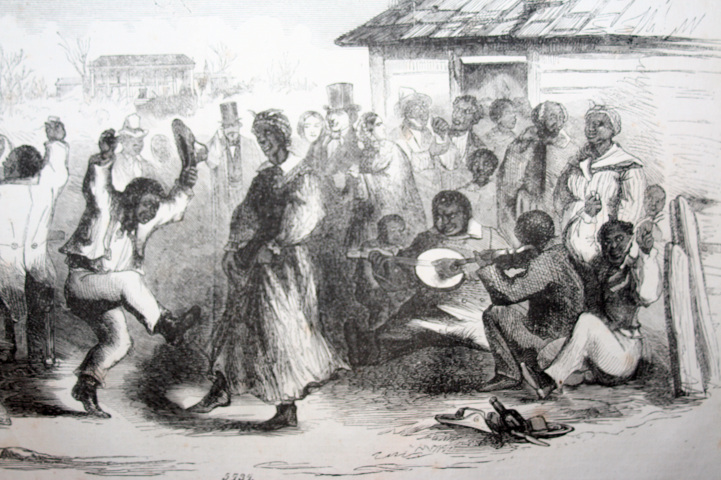
Frederick Douglass described the period of respite that was granted to slaves every year between Christmas and New Year’s Day as a psychological tool of the oppressor. In his 1845 Narrative, Douglass wrote that slaves celebrated the winter holidays by engaging in activities such as “playing ball, wrestling, running foot-races, fiddling, dancing, and drinking whiskey”. He took particular umbrage at the latter practice, which was often encouraged by slave owners through various tactics.
In My Bondage and My Freedom, Douglass concluded“the license allowed [during the holidays] appears to have no other object than to disgust the slaves with their temporary freedom, and to make them as glad to return to their work, as they were to leave it”. While there is no doubt that many enjoyed these holidays, Douglass acutely discerned that they were granted not merely in a spirit of charity or conviviality, but also to appease those who yearned for freedom, ultimately serving the ulterior motives of slave owners.
Now we know! And that is my Thought Provoking Perspective!
Make these books the gift that keeps on giving.

Thursday, December 5, 2013

RIP Nelson Mandela World Prophet

09Nelson Mandela was our generations and the world’s largest icon. Mr. Mandela is the face of freedom and the embodiment of courage as the South African anti-apartheid revolutionary. Know as an amazing politician who served as President of South Africa from 1994 to 1999 after serving twenty-seven years in prison. He was the first black South African to hold the office of president in the most reprehensible government on the planet.
Madiba, as he is called by the people of his homeland, was first elected in a fully representative, multiracial election. His government focused on dismantling the legacy of apartheid through tackling institutionalized racism, poverty and inequality, and fostering racial reconciliation. Politically Madiba was an African Nationalist and democratic socialist who served as the President of the African National Congress (ANC) from 1991 to 1997. Internationally, Mandela was the Secretary General of the Non-Aligned Movement from 1998 to 1999.
His story is the greatest story of our time. Mandela served 27 years in prison, first on Robben Island, and later in Pollsmoor Prison and Victor Verster Prison. An international campaign lobbied for his release, which was granted in 1990 amid escalating civil strife. Mandela published led negotiations with President F.W. de Klerk to abolish apartheid in which he led the ANC to victory.
Controversial for much of his life, right-wing critics denounced Mandela as a terrorist and communist sympathizer. He nevertheless received international acclaim for his anti-colonial and anti-apartheid stance, having received 250 awards, including the 1993Nobel Peace Prize, the US Presidential Medal of Freedom, and the Soviet Order of Lenin. He is held in deep respect within South Africa, where he is often referred to by his Xhosa clan name of Madiba or as tata; he is often described as "the father of the nation".
I am proud to say I have been in his presence and posed with his Ex-wife Winnie Mandela which was the most cherished moment of my life. Few people come into the world unselfishly for the benefit of others. Mr. Mandela you suffering and struggle changed and uplifted the lives of millions. In your words “Amandla” – All power to the people.
Where you go, you will be judged by the work you’ve done. You have done your work and the results of you toil will be an inspiration to the world for all eternity. Job well done; take your rest. You are my hero and the world is thankful for your spirit. And that’s my Thought Provoking Perspective…

Tuesday, December 3, 2013

RACISM ENDED!

2This is the biggest news of our lifetime – “who knew”! This comes as a big surprise to many people of color everywhere. Yes, folks - racism is dead – according to the Republican National Committee, who confirmed the breaking news via a tweet on Sunday. The Republican National Committee issued the BIG NEWS, as they celebrated the 58th anniversary of Rosa Parks refusing to give up her seat on a segregated bus in Montgomery, Alabama, by proclaiming racism has ended.
We know Rosa Parks' courageous acts and the Montgomery Bus Boycott were indeed crucial protests against a reprehensible, often violent system of racism only compared to Apartheid in South Africa. But, unfortunately conservatives refuse to acknowledge that institutional racism is still pervasive, powerful, and deeply entrenched in voting restrictions, food stamps cuts, and wealth disparities.
Several hours after the GOP declared the end of racism; they retracted their tweet and sent out a new one: "Previous tweet should have read "Today we remember Rosa Parks' bold stand and her role in fighting to end racism." But it was too little, too late: Twitter users had already begun posting with "#RacismEndedWhen" to mock the statement.
Sorry to let anyone down, and sadly much to my dismay, racism hasn’t ended! The truth is it has increased since the election of President Obama in 2008 and one could argue that it is more deliberate than at any time in our lifetime and certainly since fifty years ago when Mrs. Parks took her heroic stand.
Following the re-election of Obama in 2012, Colin Powell publicly condemned the GOP’s “dark vein of intolerance” and the party’s repeated use of racial code words to oppose the president and rally white conservative voters. Without mentioning names, Powell singled out former Mitt Romney surrogate and New Hampshire Gov. John Sununu for calling Obama “lazy” and Sarah Palin, who, Powell charged, used slavery-era terms to describe Obama.
When the right-wing comes forward with such a dishonest and disconcerting declaration of such a false reality - lookout, there is a surge a coming! Be careful who you trust because the devil was once an angel. All I can say is VOTE! And that’s my thought provoking perspective…

Thursday, June 27, 2013

Prayers For Madiba World Prophet

220px-Nelson_Mandela-2008_(edit)Nelson Mandela was our generations and the world’s largest icon. Mr. Mandela is the face of freedom and the embodiment of courage as the South African anti-apartheid revolutionary. Know as an amazing politician who served as President of South Africa from 1994 to 1999 after serving twenty-seven years in prison. He was the first black South African to hold the office of president in the most reprehensible government on the planet.

Madiba as he is called by the people of his homeland was first elected in a fully representative, multiracial election. His government focused on dismantling the legacy of apartheid through tackling institutionalized racism, poverty and inequality, and fostering racial reconciliation. Politically Madiba was an African Nationalist and democratic socialist who served as the President of the African National Congress (ANC) from 1991 to 1997. Internationally, Mandela was the Secretary General of the Non-Aligned Movement from 1998 to 1999.

His story is the greatest story of our time. Mandela served 27 years in prison, first on Robben Island, and later in Pollsmoor Prison and Victor Verster Prison. An international campaign lobbied for his release, which was granted in 1990 amid escalating civil strife. Mandela published led negotiations with President F.W. de Klerk to abolish apartheid in which he led the ANC to victory.

Controversial for much of his life, right-wing critics denounced Mandela as a terrorist and communist sympathizer. He nevertheless received international acclaim for his anti-colonial and anti-apartheid stance, having received 250 awards, including the 1993Nobel Peace Prize, the US Presidential Medal of Freedom, and the Soviet Order of Lenin. He is held in deep respect within South Africa, where he is often referred to by his Xhosa clan name of Madiba or as tata; he is often described as "the father of the nation".

I am proud to say I have been in his presence and posed with his Ex-wife Winnie Mandela which was the most cherished moment of my life. Few people come into the world unselfishly for the benefit of others. Mr. Mandela you suffering and struggle changed and uplifted the lives of millions. In your words “Amandla” – All power to the people.

Where you go, you will be judged by the work you have done. You have done your work and the results of you toil will be an inspiration to the world for all eternity. Job well done; it is time to take your rest. You are my hero and the world is thankful for your spirit. And that’s my Thought Provoking Perspective…


Saturday, May 25, 2013

The Whole Truth by Dr. John Henrik Clark


th (5)We are taught or told that the world began, in part, a few thousand years ago. This is simply false teaching concerning what is known as the Modern Era. My words and writing are intended to inspire and empower the minds of mankind. Education, that which has long been denied to most, is the single most important ingredient necessary to neutralize those forces that breed poverty and despair!

Today’s topic challenges the history of the world and proves what we've learned, much of it, untrue. Listen to the elder, the profound intellectual Dr. John Henrik Clark expose the lies. In my view the greatest mind of our time. We stand on the shoulders of giants – know it and RESPECT IT. And that’s my Thought Provoking Perspective…

Saturday, May 18, 2013

The Birthplace Of Mankind


black prencessIn the beginning there was a place of magnificent splendor was known as Pangaea where mankind was born. It consumed all of the earth’s land mass and was also the birthplace of civilization. Today, we know it as Africa. Since the evolution of its existence there have been many tribes, nations, countries, and cultures to dot its landscape. By virtue of its wealth many of these civilizations of great stature have altered the course of the world.

So for the purposes of this historical narrative exploring succinctly the African American Diaspora I must start at the beginning, in order to take you on a journey that I believe is the greatest story ever told. I will begin at a time that is significant to the African American plight around 500 AD. The region was on the coast of West Africa where there were three might empires that flourished. The empires of Ghana, Mali, and Songhai had powerful army’s and controlled great wealth that included large quantities of gold, fine manufactured goods, thriving agriculture, and enormous profits from trading.

Their empire's economic strength and centralized political control made it easy to suppress revolts. The rulers of these nations were strong, surrounded by competent loyal government officials, and military commanders who were able to unify empires composed of di­verse peoples with different languages, cultures, and geographic locations.

Ghana's ascent to great power was directly related to its acquisition of gold. The name Ghana meant "warrior king," used to refer to the empire because of its gold. It was written that Ghana's gold was so abundant that the king's dogs wore gold collars. Al-Bakri, an Arab geographer, wrote that the king owned a nugget of gold so big that he could tether his horse to it. At its height of power Ghana had a functioning judiciary system and other institutions to govern the nation’s people. The empire was ruled by a king supported by several provincial governors and viceroys. Ghana dominated the Sudan for three hundred years.

The empire of Mali differed considerably from the Ghana. It became a mighty nation in the sev­enth century when the small Mandingo state on the upper Niger River was transformed by two great African leaders - Sundiata Keita and Mansa Musa. Although Sundiata Keita began to transform the state into a great empire, its growth was slow until Mansa Musa became it ruler. 

Mansa Musa, a devout Muslim, set out in 1324 on a pilgrimage to Mecca, the holy city for Muslims. His entourage included about sixty thousand persons, including twelve thousand servants. As many as five hundred servants each carried a staff of pure gold weighing six pounds. Eighty camels carried an average of three hundred pounds of gold each. These riches were to be distributed as alms and gifts.

Upon his returned from his pilgrimage, Mansa Musa directed his architect to design buildings in Tim­buktu and other cities under his control. At times, Mali’s empire numbered far more than one hundred thousand people. During this time, Timbuktu itself had a population of more than one hundred thousand people. It was a busy place where merchants displayed their merchandise to local and international consumers. Caravans from distant places frequently came to Tim­buktu to exchange their exotic goods for gold.

Tim­buktu is believed to be the first great university, rising to its highest level of development during the Songhai’s empire between 1493 and 1529. During this time, the University of Timbuktu produced more than forty books on subjects ranging from logic, theology, ethics, mathematics, and rhetoric. Akmed Baba was the last chancellor of the university and was considered one of the great intellectuals of the sixteenth century.

In his thirty-six-year quest to make Songhai the most powerful empire in the world, Askia Mohammed embarked on an effort to expand trade to include European countries. He eventually controlled most of West Africa, an area larger than Europe. The Europeans took notice to its wealth and Askia’s greed or naiveté creating an inhumane partnership of destruction. It is my opinion and would argue this was a pivotal point in the history of our past because it was during his rule that the sale of Black slaves became a major business.

The decline of the Songhai Empire marked the end of the great West African empires. I believe it was as a result of entering into an unholy alliance to participate in the slave trade where millions were sold into bondage - never to return. As a result of this atrocity a new breed of human was created by Europeans that became known as “Negro”. The great history of this people was erased and stolen from their consciousness there by rendering them to a lost people; A nation of people living in a nation without a nationality. This was the greatest crime the world has ever known!

There are others who claim that the collapse came from the collision of two great religions Islam and Christianity. To that point, I would like you to pay attention as we travel through the Chronicles with respect to the roles each of these religions played upon a naive people. Let me ask that you are mindful that there was no word “GOD” in any African language before the coming Europeans nor was there a word “Allah” before the coming of Muslims.

Knowing that this group of people, who has endured so much degradation, now referred to as African Americans, who stand on the shoulders of giants, should unite and stand proud and tall for we are the Alpha and the Omega! And that’s my Thought Provoking Perspective…

Sunday, March 3, 2013

The Middle Passage


slaveship
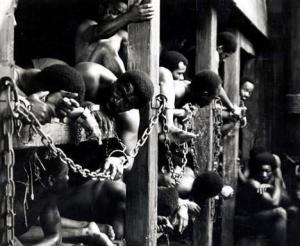
Imagine if you can, being captured, put on a force march, beaten, put into pins while shackled, and then placed in a tomb like environment with people you cannot, in many cases, communicate with for months.

These were the conditions leading to that horrible journey into the unknown for millions of African’s forcibly interned into the belly of the beast with a destination unknown. His-Story speaks to this wretched practice as part of the Atlantic slave trade. However, this was more commonly known as the "Middle Passage", which refers to that middle leg of the transatlantic trade triangle in which millions of Africans were imprisoned, enslaved, and removed forcibly from their homelands never to return.

The transatlantic trade triangle worked this way. Ships departed Europe for African markets with commercial goods, which were in turn traded for kidnapped Africans who were transported across the Atlantic as slaves. The enslaved Africans were then sold or traded as commodities for raw materials, which would be transported back to Europe to complete the "triangular trade". A single voyage on the Middle Passage was a large financial undertaking that was generally organized by companies or groups of investors rather than individuals.

African kings, warlords and private kidnappers sold captives to Europeans who operated from several coastal forts. The captives were usually force-marched to these ports along the western coast of Africa, where they were held for sale to the European or American slave traders. Typical slave ships contained several hundred slaves with about thirty crew members. The male captives were chained together in pairs to save space with their right leg chained to the next man's left leg, while the women and children may have had somewhat more room. The captives were fed beans, corn, yams, rice, and palm oil. Slaves were fed one meal a day with water, but if food was scarce, slaveholders would get priority over the slaves.

The duration of the transatlantic voyage varied widely, from one to six months depending on weather conditions. Although, the journey became more efficient over time as the average transatlantic journey of the early 16th century lasted several months, by the 19th century the crossing often required fewer than six weeks. West Central Africa and Southeastern Africa was the most common region for traders to secure the human cargo that was destined for the Caribbean and the Americas.

An estimated 15% of the Africans died at sea, with mortality rates considerably higher in Africa itself in the process of capturing and transporting indigenous peoples to the ships. The total number of African deaths directly attributable to the Middle Passage is estimated well into the millions. A broader look at African deaths directly attributable to the institution of slavery from 1500 to 1900 suggests up to four million perished but some say the number was close to one third of the Africans captured, and it is believed that nearly 60 million were captured.

For two hundred years Portugal had a quasi-monopoly on the export of slaves from Africa. During the eighteenth century however, when the slave trade accounted for the transport of about 6 million Africans; Britain was responsible for almost 2.5 million of them. In addition to markedly influencing the cultural and demographic landscapes of both Africa and the Americas, the Middle Passage has also been said to mark the origin of a distinct African social identity. These people, in American anyway, came to be known as “Negro”, which is a Spanish word that means “Black” but no Spanish country refers to its people of color that way.

Most contemporary historians estimate that between 9 and 12 million Africans arrived in the New World while others remain firm that it was more like one third of the continents population. Disease and starvation due to the length of the passage were the main contributors to the death toll with dysentery and scurvy causing most of the deaths. 

Then there were the outbreaks of smallpox, syphilis, measles, and other diseases spread rapidly in the close-quarter compartments. The number of dead increased with the length of the voyage, since the incidence of dysentery and scurvy increased with longer stints at sea as the quality and amount of food and water diminished with every passing day. In addition to physical sickness, many slaves became too depressed to eat or function efficiently because of the loss of freedom, family, security, and their own humanity.

While treatment of slaves on the passage varied, the treatment of the human cargo was never good since the captured African men and women were considered less than human. Yes, they were "cargo" or "goods" and treated as such as they were transported for marketing.

Slaves were ill treated in almost every imaginable manner. While they were generally fed enough to stay alive and supplied with water simply because healthy slaves were more valuable but if resources ran low on the long unpredictable voyages the crew received preferential treatment. Slave punishment was very common and harsh because the crew had to turn independent people into obedient slaves. Whipping and use of the cat o’ nine tails were common occurrences or just simply beaten for “melancholy.”

The scares of this and that of slavery linger to this very day. I would call the loss of land, soul, and our history as Post Dramatic Slave Syndrome. And that’s my Thought Provoking Perspective…