Showing posts with label cbc. Show all posts

Friday, November 15, 2013

The Day Innocence Died – Kennedy and Race

4
Race relations in American history have been disgraceful and more horrific treatment imposed upon African America’s than any other people ever to walk the earth. People of African descent have been enslaved, segregated, and maligned for all of America’s history, yet have remained supremely devoted and loyal. I can now understand what it must have been like when President Lincoln fought to end slavery and then was assassinated. It must have felt like their last hope was gone. Respectively, when President Kennedy was killed most African America’s relived the pain of their ancestors.  
In the 1960s one would surely find three portraits hung in just about every African American home; Jesus represented unconditional hope, strength and love; Dr. King personified the moral crusade that ended legal segregation, and there was President John F. Kennedy, who holds an important, but complicated place in black history when we look back the time in which he lived.
It’s been fifty-years since the death of Kennedy and as time has passes we're still trying to figure it out what he might have done for civil rights had he not been killed. For sure, African American’s placed hope in this man akin to that invested in Abraham Lincoln in terms of our obtaining the long awaited equality, as they both sympathized with the black struggle like no other president before them.
During Kennedy’s time in office, he did speak eloquently against segregation despite resistance from Southern racists in his own Democratic party. Some even feel that his support for civil rights was one reason he was killed, even though racial motives seldom featured prominently among the many theories about Kennedy's death.
The impact of his death in many African American homes at the time was like that of losing a family member. Its effect was like a big cloud over the whole black community, an aura of hopelessness. Just look back at the pictures of the funeral, you see so many black people out there crying. Mind you, this was at a time when African Americans were barred from most, if not all, public accommodations.
In a speech soon after meeting Dr. King, Kennedy spoke of the "moving examples of moral courage" shown by civil rights protesters. Their peaceful demonstrations, he said, were not "to be lamented, but a great sign of responsibility, of good citizenship, of the American spirit." He went on to reference the growing "sit-in" movement, in which black customers demanded service at white-only restaurants, Kennedy said: "It is in the American tradition to stand up for one's rights even if the new way to stand up for one's rights is to sit down."
Let’s be clear; he was a white man and wanted to steer clear of the issue of race for political reasons. However, he endeared himself to the African American community when Dr. King was in jail. Over the objections of his brother and campaign manager, Robert Kennedy, an aide managed to convince the candidate to place a sympathetic call to King's pregnant wife, Coretta. Soon thereafter, Robert Kennedy called the judge. Suddenly, bail was granted, and King was freed.
The story of the Kennedys' involvement made headlines in black newspapers nationwide. King issued a statement saying he was "deeply indebted to then Senator Kennedy," although he remained nonpartisan. The Kennedy campaign printed tens of thousands of pamphlets describing the episode and distributed them in black churches across the country on the Sunday before the presidential election. He would get 78 percent of the black vote, won the election by one of the narrowest margins in U.S. history.
When Kennedy became president, his top priority was foreign policy. There were enormous Cold War challenges, from the Soviet Union and Vietnam to Cuba the site of the failed Bay of Pigs invasion and of the crisis over Soviet missiles that threatened to trigger a nuclear war. At the same time, the civil rights movement was boiling and could not be ignored. "Freedom Riders" seeking to integrate Southern bus lines were mercilessly beaten. Whites rioted to prevent the black student James Meredith from enrolling at the University of Mississippi; two people were killed after Kennedy sent in troops to ensure Meredith's admission.
In Birmingham, Ala., police loosed clubs, dogs and fire hoses on peaceful protesters, and a church bombing killed four black girls. Images of the violence shamed America before the world and as African American blood flowed, Kennedy moved cautiously toward civil rights legislation. Publicly, the Kennedy administration was reluctant to intervene in the Southern violence unless federal law was being flouted. Privately, Kennedy's men urged protest leaders to slow down and avoid confrontation.
In light of foreign policy issues, civil rights simply was not a top priority. It could be said that he allowed J. Edgar Hoover, head of the FBI, to deal with the Negro problem, which was a bad idea. Hoover believed the growing civil rights movement was under Communist influence and a threat to national security. He closely monitored King and others in the movement with surveillance, informants and wiretaps. He went so far as to refuse to warn King as it routinely warned other potential targets. In spite of Kennedy publicly working with King, even as his FBI tried to tear King down, he paid both sides of the issue.
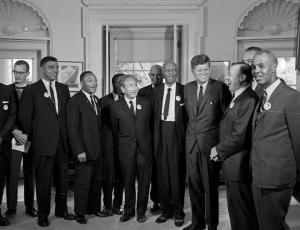
Kennedy also opposed to the March on Washington using the argument that he wanted success in the Congress for any civil rights legislation. In the end, the peaceful mass march made headlines around the world. Kennedy watched it on television. Immediately afterward, he met with march leaders in the White House, where they discussed civil rights legislation that was finally inching through Congress. The leaders pressed Kennedy to strengthen the legislation; the president listed many obstacles.
During a speech at San Diego State College in June 1963 Kennedy said, "Our goal must be an educational system in the spirit of the declaration of independence — a system in which all are created equal," Kennedy said. "A system in which every child, whether born a banker's son in a Long Island mansion, or a Negro sharecropper's son in an Alabama cotton field, has every opportunity for an education that his abilities and character deserve." This was dangerous for the time and not acceptable language by the dominant culture. This put him on the enemy list not only for political retribution, but for death.
If it were not for the 50th anniversary of his death few African Americans would mention his name. Young people barely remember him; there are no aging portraits on the walls, and certainly he is not remembered as a civil rights icon. It was his successor, President Johnson, who receives credit for hammering through the monumental Civil Rights Act and Voting Rights Act, which ensured full citizenship for African-Americans.
Whether Kennedy might have achieved anything substantial on civil rights or for black people, we will never know but he was a breath of fresh air, youthful, dynamic, and in my view a new visionary type of leader full of optimism and hope.
Disclaimer: The information contained in this series is that of the presenters and does not necessarily reflect the views of the author. It is information that is in the public domain provided for the reader to form an opinion. Whereas, it is the author’s position that the most profound sin is a tragedy unremembered and the absence of truth. And that’s my thought provoking perspective…

Friday, April 26, 2013

His-Story: The Bush Library


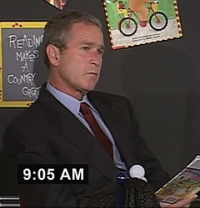
amd-bush-pet-goat-jpgHistory has repeatedly shown that, as it is written, it is generally a pack of lies. Well “W” is in the spotlight as he gets to reinvent a narrative to reflect his presidency. This is always a good thing, if there was something positive or meaningful to say. I seriously doubt there will be anything that reflects what most of us view as a disaster. The first clue was choosing “Shooter” as Vice President!

In my view there were several issues or failures of his two terms as president. One was the lasting image of his continuing to read a picture book to grade-schoolers after his top aides told him that the World Trade Center’s had been attacked on 9/11. The second thing that stands out is his response to hurricane Katrina. Can’t you still see him smiling as he looked out of the window of Air Force One during his “fly-bye” or over of New Orleans and when he finally showed-up all the heaping praise he gave Brownie for doing a “heck of a job”?

I understand that history is written by the victors and long after those who witnessed the events are dead – the story will change and a very different rendition will be installed. We should have known his presidency would be a disaster from the very start when he stole the election. He came into office with a sizeable surplus and left America with the worst financial crisis since the 1930s. Of course we should remember “No Child Left Behind” where every child was left behind.

On his watch the worst attack ever on American soil occurred which caused him to take us into two unfunded wars where we are still fighting ten years later. Not to mention all of the deaths and carnage from them during his reign. Surely we cannot forget the “tax cuts” for the rich. He is in most circles known as the biggest spender of any president. Ok, just hold on I am going to get to something good!

The good part is that his presidency will fall behind Nixon and Andrew Johnson who distinctively said, “"This is a country for white men, and by God, as long as I am President, it shall be a government for white men." -- Andrew Johnson, 1866

Many will remember Bush as a contender for the "worst president ever". More might argue that he more aptly deserves a multi-million-dollar prison cell for a litany of war crimes and not a structure filled with misgivings, he calls a presidential library. With this he can now say “Mission Accomplished”. And that’s my Thought Provoking Perspective…

FaceBook @ John T. Wills
Like my FaceBook Page
Twitter @ John T. Wills


Saturday, December 22, 2012

A Slave’s Christmas


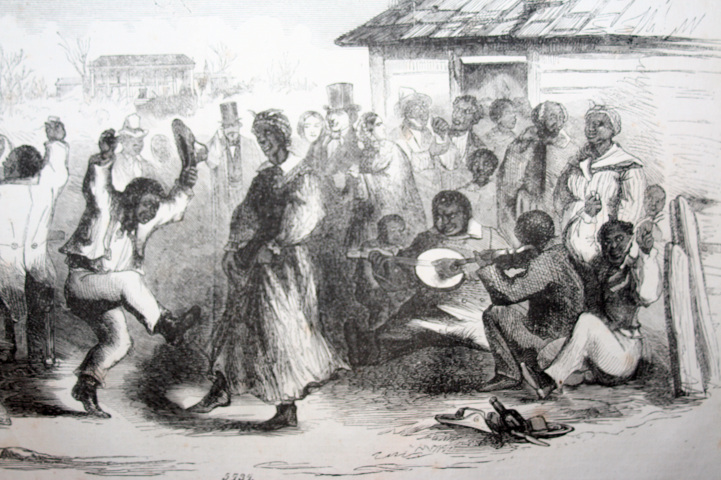
slave xmasAfrican American, arguably, are the most religious people on this little rock called earth and have always been since arriving in this place the slaves called “merica”. With that said, I am sure many have wondered, in spite of the wretched system of slavery, how was it celebrated by the slave population?

The American slaves experienced the Christmas holidays in many different ways. Joy, hope, and celebration were naturally a part of the season for many. For other slaves, this holiday conjured up visions of freedom and even the opportunity to bring about that freedom. Still others saw it as yet another burden to be endured.

I suppose the enslaved African Americans; if there was ever any joy, it might well have been during the Christmas. At least their capturers, in the spirit of Jesus’ birth allowed them to have a day free from drudgery. The prosperity and relaxed discipline associated with Christmas often enabled slaves to interact in ways that they could not during the rest of the year.

They may well have received material goods from their masters: perhaps the slave’s yearly allotment of clothing, an edible delicacy, or a present above and beyond what he or she needed to survive. For this reason, among others, slaves frequently married during the Christmas season – that is if it was allowed. More than any other time of year, Christmas provided slaves with the latitude and prosperity that made a formal wedding possible.

This ironic annual inversion of power occasionally allowed slaves to acquire real power. Henry, a slave whose tragic life and death is recounted in Martha Griffith Browne’s Autobiography of a Female Slave, saved “Christmas gifts in money” to buy his freedom. Some slaves saw Christmas as an opportunity to escape. They took advantage of a relaxed work schedules and the holiday travels of slaveholders, who were too far away to stop them.

While some slaveholders presumably treated the holiday as any other workday, numerous authors record a variety of holiday traditions, including the suspension of work for celebration and family visits. Because many slaves had spouses, children, and family who were owned by different masters and who lived on other properties to which slaves often requested passes to travel and visit family during this time. Some slaves used the passes to explain their presence on the road and delay the discovery of their escape through their masters’ expectation that they would soon return from their “family visit.”

Jermain Loguen plotted a Christmas escape, stockpiling supplies and waiting for travel passes, knowing the cover of the holidays was essential for success: “Lord speed the day!–freedom begins with the holidays!” These plans turned out to be wise, as Loguen and his companions were almost caught crossing a river into Ohio, but were left alone because the white men thought they were free men “who have been to Kentucky to spend the Holidays with their friends”.

It was during Christmas that Harriet Tubman helped her brothers escape. Their master intended to sell them after Christmas but was delayed by the holiday. The brothers were expected to spend the day with their elderly mother but met Tubman in secret. She helped them travel north, gaining a head start on the master who did not discover their disappearance until the end of the holidays. Likewise, William and Ellen Crafts escaped together at Christmastime. They took advantage of passes that were clearly meant for temporary use.

Christmas could represent not only physical freedom, but spiritual freedom, as well as the hope for better things to come. The main protagonist of Martha Griffin Browne’s Autobiography of a Female Slave, Ann, found little positive value in the slaveholder’s version of Christmas equating it with “all sorts of culinary preparations” and extensive house cleaning rituals but she saw the possibility for a better future in the story of the life of Christ.

“This same Jesus, whom the civilized world now worship as their Lord, was once lowly, outcast, and despised; born of the most hated people of the world . . . laid in the manger of a stable at Bethlehem . . . this Jesus is worshiped now”. For Ann, Christmas symbolized the birth of the very hope she used to survive her captivity. Not all enslaved African Americans viewed the holidays as a time of celebration and hope. Rather, Christmas served only to highlight their lack of freedom.

Frederick Douglass described the period of respite that was granted to slaves every year between Christmas and New Year’s Day as a psychological tool of the oppressor. In his 1845 Narrative, Douglass wrote that slaves celebrated the winter holidays by engaging in activities such as “playing ball, wrestling, running foot-races, fiddling, dancing, and drinking whiskey”. He took particular umbrage at the latter practice, which was often encouraged by slave owners through various tactics.

In My Bondage and My Freedom, Douglass concluded that “the license allowed [during the holidays] appears to have no other object than to disgust the slaves with their temporary freedom, and to make them as glad to return to their work, as they were to leave it”. While there is no doubt that many enjoyed these holidays, Douglass acutely discerned that they were granted not merely in a spirit of charity or conviviality, but also to appease those who yearned for freedom, ultimately serving the ulterior motives of slave owners.

Now we know! And that is my Thought Provoking Perspective!

Make these books the gift that keeps on giving.


Tuesday, November 13, 2012

And Our Story Continues


We've spent the last three years revisiting what we thought was long past. Witnessing the vitriol of those who want to recreate what I call Brownsville, you know, those segregated places mandated by law as a result of the wretched system of “Separate but Equal”; more commonly known as “Jim Crow”. I have tried to resurrect the ghost of the greats that changed the world, which have caused me to live a life promised to all Americans. Having said that, I readily admit there is still a long way to go.

On Election Day this magnificent journey and life’s promise continues with the reelection of President of Barack H. Obama. Since I started THOUGHT PROVOKING PERSPECTIVES I have shared the African American journey that is without question the greatest story ever told. Maybe I’ll say this more succinctly by quoting Jesse – “From the outhouse to the White House”. The irony of this was that Africans were dragged onto the shores of this place the slaves called “merica” to now having a man of African descent in the White House as President. 

This evolution brought about our acquiescence to political agendas, abdicating our own economic self-sufficiency for the greater good and most working diligently for the economic well-being of other people. Since the 13th, 14th and 15th Amendments were written many have died for the rights described therein and we continue to fight for equality.

Since Black History month only comes in February it’s time we appreciate it every day. I want to leave you with this thought from “The Mis-Education of the Negro,” the most profound novel ever written in my opinion, originally published in 1933 by Dr. Carter G. Woodson, who is known as the father of Black History Month. I might add that this book should be mandatory reading for all African Americans – young and old.

The thesis of Dr. Woodson's book is that Negroes of his day were being culturally indoctrinated rather than taught in American schools, or not even given the advantage of education. This conditioning, he claims, causes African Americans to become dependent, seeking out inferior places.

He challenged his readers to become empowered by doing for themselves, regardless of what they were taught: “History shows that it does not matter who is in power... those who have not learned to do for themselves and have to depend solely on others never obtain any more rights or privileges in the end than they did in the beginning.”in the greater society of which they are a part. This assertion is clearly evident nearly eighty years later.

This goes beyond the imagination, irrespective of the many promises that have been made and broken, that fairness exists. Don’t worry, we have been taught that when we die there is a place where there is a mansion with streets paved with gold. Be that as it may, let's agree with the great Curtis Mayfield who wrote: “people get ready there’s a train a comin. You don’t need no ticket. All you need is faith to get on board… you just thank the lord.”

I have said and believe that Black History Month is “Black History is American History”. We have witnessed the first man of African descent elected president of these United States and nothing more significant has happened since the resurrection of Christ. I am thankful to have lived to see what no one living or dead ever thought would occur. God Bless America President Barrack Obama and the greatest story ever told continues!

And for those who want to succeed from the Union. We have seen this movie and how did that workout for them. And that is my Thought Provoking Perspective…

Legacy – A New Season 
Just a Season